Saturday, December 15, 2012

Going with the Phlomis...


I realize this looks suspiciousliy like Lamb's ears--and the Phlomis are distantly related, it's true--but these fluffy, very touchable leaves are one of the innumerable "Jerusalem sages" that have barely entered cultivation, or have yet to do so...the Mediterranean is chockablock full of Phlomis--and strangely few are out there. This is one that Dan and I collected half way up the Sierra Nevada above Granada, little suspecting it would have such lovely, burnt orange flowers...


Which I have yet to photograph properly. I suspect if I take the time and photograph this in just the right light, it will get the notoriety it deserves. Dan has propagated dozens of plants which now cover a wide swath of the Watersmart garden, producing buckets of seed. Now if it would only do this in MY garden!

 
Here is yet another execrable picture of a fabulous plant, in this case Phlomis lychnitis--we managed to get only a little pinch of this at a high elevation on Sierra Mágina, a magical mountain in Andalucia. I shall never forget the day or the plants there: practically the whole mountain for miles was wall to wall Phlomis lychnitis--all with seedpods sticking up, and ALL were empty, except for one which had a few flaky black seed. I think only one germinated. and this one has persisted at DBG, and despite Mike Bone growing dozens of seedlings a few years ago from our home grown seed, it is still not being sold by K-Mart (in fact, I think we still just have one or two measley plants). It is really not so easy to introduce plants, no matter what the Plant Nazis say!


Here's a closeup of a dwarf Phlomis that Marcia Tatroe grows to perfection. Alas, it never produces seed (she says: I secretly think she's hoarding it and just enjoys watching me writhe with envy each spring when I visit). She keeps telling me the name, which I suppress. I think it is close to P. armeniaca--but truth be said, there are several dozen dwarf yellow Phlomis, one cuter than the next..
.

Here's my picutre of a very different Phlomis I took in the Tian Shan in 2010: it grows EVERYWHERE there, and also in the Altai: Phlomis oreophila has not proven as amenable as I'd hoped--although we collected much seed. I'm afraid we've been treating it too harshly--it does like alpine conditions and lots of moisture. I'm growing the somewhat similar Phlomis bracteata which I admired in Pakistan, so I hope we can finally tame this one: it is wonderfully wooly for much of its juvenile stage as it emerges in the spring....surely a plant this abundant and widespread in the wild will be growable?

And then there is this little munchkin: I got this decades ago from an Index Seminum, and it has persisted cheerfully in the same spot in the Rock Alpine Garden. Truth be said, I'm not sure I trust the name: it looks so similar to a bevy of Sideritis I have grown, and come to think of it it could almost pass for Stachys citrina: that pale yellow color seems to be widespread in Mediterranean mints. I love this thing, but I have not researched it: the flower morphology screams Sideritis to me: I wonder if there's been a mistake?

Is it not strange that such wonderful plants, with evergreen foliage (mostly) and a long season of summer bloom have not gotten more attention? I for one will not be content until I've grown every species of Phlomis on the planet, and then some!

I believe this genus has got to be one of the very best for xeric gardens...now to fetch the other hundred or so species we're still missing!

Sunday, December 9, 2012

Autumn embers redux (April in December?)

 
Autumn embers still? And what's this "April in December?"--hold your horses, it'll all come out in the wash! The "April in December" is the easy part: April is the perfect month at the beginning of the growing season. March is a tad too early (and ragged around the edges, so to speak) but by April the bulbs are all out in force, the first lilacs and flowering trees are blooming and the alpines are going great guns: everything is crisp and full of promise and the hailstorms and summer droughts and insects have yet to take their toll. December represents a similar sort of perfection: We've finally managed most of the fall cleanup, and the beds are pretty trim, the last bulbs planted, and the last fall color is glowing and lots of bulbs are actually poking up their cute little noses (you should make some squeaky sounds here)...winter has yet to wreak its worst--and one can admire with optimism the many new succulents (and other plants of untested hardiness) you have put out before they are blasted to oblivion...hopefully not the Cotyledon orbiculata pictured above. This is the chubby, very silvery form that Agua Fria nursery says they obtained from me nearly 20 years ago which they have grown for years and propagated...finally coming home to roost, as it were, in the very best, steep crevicy spot I could find... 
 
This is a hunkering giant form that Dan Johnson planted in front of Marnie's Pavilion. It made it through last winter...and grew enormously this summer...I walk by here several times a day at work, and needless to see I shall be observing its progress through the next few months with intense curiosity! 
 
I've grown several Nananthus in the past--one (N. transvaalensis) bloomed through much of the winter one year. I believe this is N. vittatus--and it has been blooming from late November to this past week. Any plant witty enough to bloom this time of year has got to be a keeper--now let's just hope it keeps alive through this winter! Most Nananthus I have grown in the past bloom in April, funnily enough...(Here you should prop your right elbow on your left palm, and scratch your chin thoughtfully with your right index finger, saying "Veeeeeeeeeery interesting".)
 
 
I have grown quite a few Narcissus bulbocodium in my day, and they have always bloomed for me in, yes, April. Last autumn I obtained six bulbs of Narcissus cantabricus from Brent and Beckys and was disappointed when they did not bloom this last April. Lo! and Behold, a month or so ago I noticed buds near the base of the stem...precocious buds for next spring? A few weeks ago the first bud opened, and since then three of the plants have come into full bloom. I shall be intrigued to see how they make it through the next few nights in the lower teens!


Above is a closer look at N. cantabricus--which does bear a strong resemblance to its cousin below....

 
This is Narcissus albidus var. foliosus, planted this year from Mark Akimoff and Jane McGary's outstanding bulb list. It has not been through the winter, but I realized I have another clump from them that did make it through last winter unscathed, but without blooming yet...it opened its first flower in mid November and is still blooming on December 9...by the way, we've had almost summery weather in that interval (days often in the 70's: what better definition of a steppe climate: a place where spring flowers bloom in late autumn with summerlike days when it should be winter!)
 
 
Here is the late autumn/early winter view of my rock garden slope I featured in a blog several years ago. That year I took the picture of this same slope in October (this October the slope had not turned color)...it is instructive to compare the two pictures--they both are surprisingly similar. Hence my revisiting "Autumn embers".


Hardly April, I know--but there is a wonderful blend of Rembrandtian colors in the early winter (as opposed to the Giotto tints of April). The bright white clump in the front left is Sideritis cypria--a wonderful new plant that is untested for hardiness--what will it look like in April? And the Green rosettes at 4:00PM (birders will know what I mean) is Erigeron glaucus--a coastal California-Oregon endemic that burns pretty badly most winters, but comes back. And so it goes around my garden--lots of promise and many questions...and much the same excitement that April brings in a different way. And we're only four months away!

Thursday, December 6, 2012

прощание


Farewell


....Thus life has been an endless line of land
receding endlessly.... And so that's that,
you say under your breath, and wave your hand,
and then your handkerchief, and then your hat.
To all these things I've said the fatal word....
"Softest of tongues" Vladimir Nabokov (the fatal word is "прощание"=farewell: pronounced "praschay" more or less...)

Don't be alarmed: I'm not going anywhere. Yet. I am simply acknowledging the universality of leavetaking (something we do every day: you break a spatula. You throw it away--and shall never see it again [ever] although it was something you used for years almost every day): that simple parting repeats itself every moment: that very breath is gone never to return, that sunset was unique and evanescent--and then there comes a certain age when you quite often see old friends for the last time quite frequently: I took leave of more people in the last year, shaking their hands or even hugging them for the last time (and yet not realizing it would be so until a few weeks or months later when I attended their funerals...)


I took this fun picture of my friend, Harlan Hamernik, with his Plant Select award in June never suspecting that would be the last day I would ever see him.

Vladimir Nabokov (far and away my favorite 20th Century author) wrote "Softest of Tongues" in the Atlantic Monthly in 1941--saying farewell to the Russian Language which he had decided to abandon in favor of English (he was 42 years old, and had been writing professionally in Russian for nearly 20 years at that point--and had come to be acknowledged by many emigres as their premier author at the time). Leaving your native language for a writer is a sort of death. Venturing forth in a new language...with tools of stone as he says...he had no idea where it would lead. But he captured that extraordinary pang of loss in that superb little poem...although he does revisit the Russian Language in his second greatest English poem a few years later: you can actually hear him reciting "An Evening of Russian Poetry" in 1958 if you click on that link! More bittersweet nostalgia for us "preterists" (and heady stuff it is too if you grok it).

But this is blog is not about Nabokov: it's about leavetaking of gardens and suchlike: some merely change. For nearly ten years I helped create and maintain (along with Denver Master Gardeners) a garden for Mayor Hickenlooper at Civic Center: last summer it was completely changed and is now maintained by Parks staff again: I shall have to dedicate a whole Blog to that bittersweet story [it might even merit a book]. Here is a picture of that garden a few years ago...


And likewise Centennial Garden (which I helped design)--once one of four of DBG's "main" gardens, it was jettisoned (for those everpresent fiscal reasons) four or more years ago and is now succumbing to a sort of elegant entropy: here's a picture of Centennial in the spring:


Below is its mirror parterre in late summer: Zinnia grandiflora as a groundcover over bulbs. That was brilliant (I'd like to also think it was my idea)...Maybe it was? I certainly did suggest the Mountain Mahogany as hedge.


In the course of my 33 years tenure at Denver Botanic Gardens, I would guess I have seen nearly 100 garden changeovers: for instance, the area that is now our Bonsai Pavilion was an official American Rose Society test garden when I came: I transformed part of this into an ice plant test garden in 1982 and subsequently it went through several iterations I have completely forgotten (they must have been memorable) before being turned into a cutting garden in 1999-2001 which was stunning for nearly ten years, when it was turned into a holding area for construction projects for several years, and this past winter was transformed into our stunning new Bonsai area. Wildflower Treasures (which I worked on so much I'd call it WFT) was created about the same time as the Cutting Garden as part of the "Rob Proctor" era--he and I designed what may be the most "botanical" garden ever--a wonderful accurate if stylized depiction of Colorado ecosystems through the prism of art. This garden was extremely popular with sophisticated visitors. Today it is a blank slate (it will be transformed into a vegetable garden extravaganza this winter)...


I hasten to say that those giant troughs--built by Mark Fusco and originally planted by my ex-wife Gwen Moore--have been preserved and will hopefully be moved to Chatfield next spring...

Am I bitterly disappointed? A piece of me is. I was asked early on in the process by several of the "eminence grise" of the Gardens if I objected to the change (presumably they would have fought it). I am frankly so thrilled by the colossal transformation at DBG that has transpired in the last six years since Brian Vogt became director that I felt that this single "setback" was trivial stuff: besides which I am a strong believer in the current "Vegetable Boom" and think that the new garden will do much to help sustain it...

More to the point, this garden had 10 years of glory--not bad for a public garden! And has been secretly and accidentally reincarnated in a much more glorious and artistic and much larger format by Lauren and Scott Ogden around the Visitor Center at Denver Botanic Gardens at Chatfield (where they designed the perennial component much more artistically than Rob and I did in WFT): so there has been a net gain in the big picture...I'm a big picture kinda guy--you gotta get! WFT is leveled, but WFT lives on at Chatfield! Long live WFT!

And finally there is High Country Gardens, which David and Ava Salman created 19 years ago as a "sideline" for their incredible nursery Santa Fe Greenhouses. I would love to know how many millions of catalogues the Salmans sent out in those 19 years: I guess at least ten million. That enterprise brought the very highest standards of plantsmanship and artistic expression of Western Horticulture to an unparalleled mass market. I've had an inkling for a year or two that things were not going well and that one or another of their garden centers in Albuquerque or Santa Fe might close. I had no idea that everything: their Bernalillo growing areas and catalogue operations, would be put up for auction and that the whole shebang would end abruptly.


Here's David in one of his greenhouses looking at what might be the very best hardy Salvia of the microphylla/greggii persuasion yet...the picture was taken barely a month ago--about the time the final decision was being made no doubt...

People ask me why? I answer that 19 years is a hell of a run for any nursery. The Salmans released an explanation that the economic conditions in New Mexico these last few years (exacerbated by drought and fires) decreased profitability such that the corporation did not feel it was wise to continue. I have a hunch this is the bald truth in a nutshell. And yet none of us can imagine the enormous energy, effort and just plain hard work that goes into managing hundreds of people and literally millions of plants over a period of decades. The Salmans have earned a break--and we should just count our lucky stars we had High Country Gardens and Santa Fe Greenhouses as long as we did! Thank you, David and Ava, for your shimmering and enormous gift (I have a big section of my bookcase dedicated to your catalogues I shall always treasure). And I look forward to what comes next! прощание!

I began with Nabokov, but I shall end with Prospero's exquisite leavetaking in
"The Tempest"...possibly the loveliest valediction ever written.

...Our revels now are ended. These our actors,
As I foretold you, were all spirits, and
Are melted into air, into thin air:
And like the baseless fabric of this vision,
The cloud-capp'd tow'rs, the gorgeous palaces,
The solemn temples, the great globe itself,
Yea, all which it inherit, shall dissolve,
And, like this insubstantial pageant faded,
Leave not a rack behind. We are such stuff
As dreams are made on; and our little life
Is rounded with a sleep.

             William Shakespeare


Monday, December 3, 2012

The greatest rock garden plants?


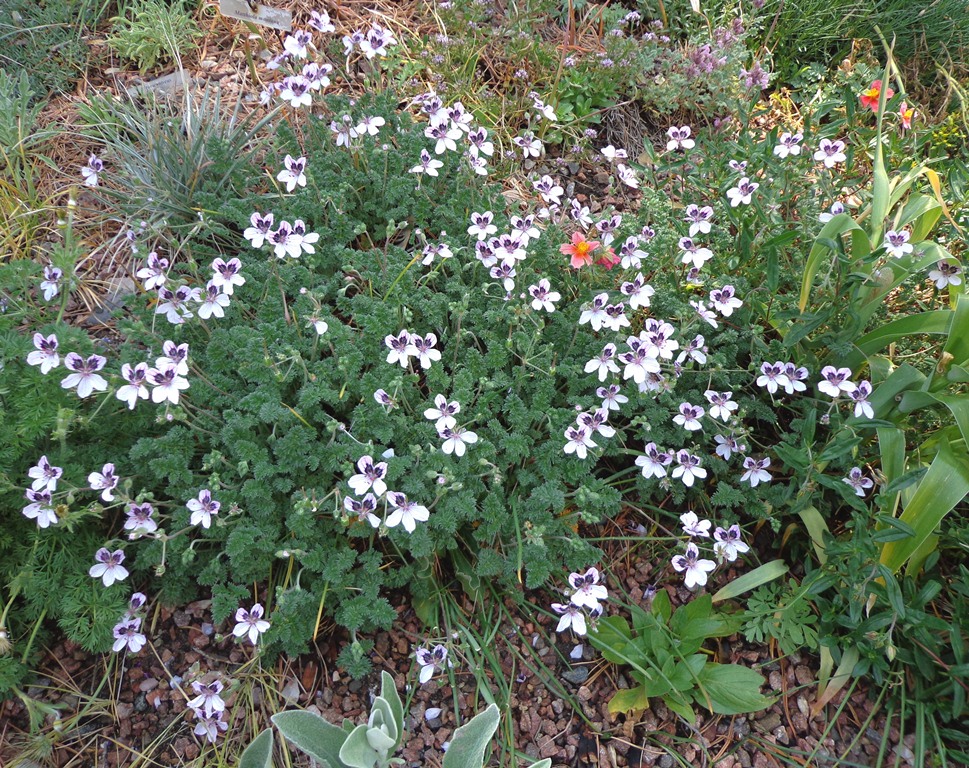
 Androsaces, gentians, primroses, saxifrages and all their alpiny ilk are so brilliantly colored, so spectacular in their performances, like Prima Donnas who have hogged the mike and utterly upstaged those quiet, somewhat less flamboyant but ultimately more talented character actors that often carry the show. The genus Geranium has become a mainstay in perennial gardens, but Erodium has not really gotten its due, especially in rock gardens where they shine and shine for months on end. Long after the last primula and aubrietia have faded, the erodiums bloom and bloom. And even in the short months when they are not blooming, their filagree foliage adds color and interest to the garden. Filagree! That may be the problem...filaree (Erodium cicutarium) looks uncannily like its more worthy cousins, with bright pink flowers and trim, ferny rosettes that turn a brilliant red in winter. Only this last is a horrendous and pestiferous weed around the world--it's much more restrained cousins have paid the price, I fear...including tiny morsels like the Erodium petraeum selection above...


Taller and rangier, Erodium cheilanthifolium has been lumped botanically with E. petraeum and even E. crispum--as well as a half dozen other ferny leafed, silvery Erodiums that grow in the mountains surrounding the Mediterranean. Splitters have named many of these, but lumping botanists have blurred the lines excessively, in my opinion. I grow a variety of these in my home gardens, and they are distinct enough to include in an even small rock garden collection. There have been many hybrids between these "species" which only adds to the confusion: I suspect the nomentclatural madhouse that these silvery, dense cushioned erodiums are in may be part of the reason they are avoided by gardeners!


As you can see from the first three I have shown, different forms are quite distinct in effect in the garden, so it is worth seeking out a variety of these--the flowers are fascinating up close with their colorful blotch and striations, and the plants make a decent impact from afar. And I daresay there is not a day between April and October when there won't be a few flowers on these to look at: is that a winning trait in a plant or what?


Lionel Bacon, past president of the Alpine Garden Society of England, was responsible for first collecting and disseminating two similar and very showy species from Spain: Here I show the slightly smaller of the two (size seems to be their main distinction), Erodium castellanum generally stays under 8" tall, while Erodium daucoides can send flower stems above a foot in height. Both species have flowers in that bright lavender-magenta shade that seems to have been perfected by the genus. And the markings are never quite the same from plant to plant: definitely a keeper!

You can see once again that these plants are fascinating up close, but they make a long season of  bright color from afar--and the foliage is evergreen to boot: not many rock garden plants can boast that kind of versatility!

Erodium macradeum looks superficially like the previous two species, but the tuft is generally looser, the foliage more coarsely cut and the flowers even brighter and larger. It never produces the lavish displays of its fellow lavender pinks, but the flowers make up for their sparesness by being especially brilliant. All of these are quite long lived in the garden, and if you plant more than a few plants, you are apt to get seed and lots of welcome seedlings over time to perpetuate you colonies...


Few plants seem to have attracted more Latin names than this tasty morsel: Erodium trifolium, E. malviflorum, Erodium pelargonifolium, Erodium hyenoides and probably more...I hasten to say that it can be very spready by seed in some gardens. I find it very manageable in Denver--where our winters seem to keep it somewhat in check. The wonderfully hairy, rounded leaves are quite distinct from other Erodium, and the wonderful, two-toned flowers are distinctive and showy and very floriferous. Despite its obvious charm, it's annoyingly rare in cultivation. Why is that?


If there is one Erodium I would think deserves landscape use, that would have to be Erodium chrysanthum (or whatever this turns out to be: there is good evidence the commonly cultivated clone may be a hybrid). This plant, growing in the Rock Alpine Garden at Denver Botanic Gardens is well over 30 years old in that spot, and now is well over a meter across. It blooms as prodigally as any erodium, but in this case that wonderful silvery moonlight yellow color over a dense cushion of silvery leaves: enchanting! The Plant Select introduction program included this as a recommendation in 2011.

Here is a wonderful pale pink hybrid called 'Joy' that captures the elegance of the genus and combines it with some hybrid vigor. Here growing in the Rock Alpine Garden...


The gem of the genus has to be Erodium absinthoides ssp. amanum, from that fascinating mountain range on the border of Turkey and Syria where one may not want to go camping this winter. As you can see, this form (originally from Robin Parer, growing in Mike Kintgen's private garden) is an amazing blue violet color--and seems to have an even more protracted season of vivid bloom.

Strangely enough, there are still dozens of erodiums I haven't mentioned...some, like the popular E. reichardii (E.chamaedryoides) are not truly hardy in our Zone 6 gardens. Others (E. carvifolium) are superficially much like those I've shown. But others--(like E. sibthorpii, E. x lindavicum, E. manescavii, E. celtiibericum) have escaped my camera, or I would have included them. And let's not even TALK about the many outstanding hybrids. Gorgeous (and variable) evergreen foliage, an extraordinarily long bloom period, easy and adaptable in the garden, adorable closeup and yet having landscape impact: can you name another genus of plants that has all that and more?  Have I convinced you yet that Erodium is not the best rock garden plant genus, containing real garden riches?

Friday, November 30, 2012

Molly the Witch

 
We are now less than half a year away from the time when Molly the Witch (Paeonia mlokosewitchii) casts her spell: she almost always blooms for Mother's day--or even a tad earlier in these days of earlier springs. As you gain your horticultural stripes in colder regions, you must somehow get your mitts on this subtle queen of wild peonies.
 
 
Here are the shoots in March and early April...emerging in my home garden...even at this early and rather provocative stage, Molly is arresting! 
 
 
Here she is in her full glory, this clump happens to be at Laporte Avenue Nursery in Fort Collins--one of the few nurseries that regularly grows this gem. Although I can't guarantee they always have it in stock (it does tend to sell out quickly)...
 
 
Here's a fine specimen on Ridge Road in Littleton--at the Snyder garden. I suspect more than one passing motorist has swerved...
 
 
Even in seed it is a wonder in the garden. Why am I writing now, in the early days of winter about this glory of early spring? Well, friends--when Molly is blooming I am bewitched by a thousand or more gems that are popping up everywhere (and this coming year I am likely to be in Sweden)...that's what blogs are for, silly: a chance to linger over the year and glom on to a few gems like this that enrich our lives so much. We have one specimen of Molly at Denver Botanic Gardens that must be 30 years old and just gets better and better. Every year I find my way down to it and spend a few minutes enthralled: that sort of ritual fills the life of a gardener with magic moments. If you've found your way to Prairiebreak, I know you know!
 
I think that botanists have recently lumped this into some other Caucasian taxon. We horticulturists are not apt to change too quickly! It does get better: at Gothenburg Botanic Gardens almost twenty years ago I saw a tiny form of this that was deep golden yellow from Iran...it did not survive the trip back back then: time to write Zetterlund and beg some more seed!

Tuesday, November 27, 2012

Fearful symmetry

 
Sunday night Jan and I went to see "The Life of Pi"--which despite having rave reviews only had a dozen or so people in the huge theatre. I thought this Watercolor tiger painting (which you can purchase if you click on the hyperlink!) captured a bit of the essence of the movie--as well as Blake's classic poem at the bottom.  Richard Parker (the tiger in the movie) was the kicker for me: how the hell they could have done such an astonishingly perfect job of cyberartistry with this awesome cat? Apparently, the critters in the boat are all phony cyber creations, although they looked distressingly real to my eyes. I don't want to spoil your appreciation of this movie--it is well worth seeing on many levels. But I realized watching it that much of my life has been a struggle with my own personal tiger. Piscine (the protaganist) implies at the end that perhaps Richard Parker (the tiger antagonist) was in fact himself...I said the movie operated on many levels!
 
I've read two biographies of Bruce Chatwin, and they both mentioned Bruce's great interest in Dinofelis, a Miocene carnivore that appears to have specialized in eating our ancestors. The terror inspired by tigers in particular, may be a deep-seated human instinct inspired by millions of years of eluding (or trying to elude) the ironically named Smilodon. What if our intelligence came about as a direct result of "smarter" humans being selected because they found better ways to elude their ultimate predator and lived to procreate, passing on ever smarter genes?
 
I have a hunch that those increasingly smarter humans may have eventually developed methods to drive Dinofelis into extinction After all, paleontologists believe humans have driven dozens of other taxa of megafauna off the earth in the last tens of thousands of years through our extraordinary capacity for, well, let's be blunt--our mastery of destruction.
 
May I suggest (just as the "Life of Pi" seems to) that we are ourselves in fact the tiger. Until we manage to subjugate or at least grasp this fact that is. The tigers of ignorance and hate, greed and anxiety, guilt and fear are the creatures that drive so much of what we do from day to day. They do damage of course on their own, but also preoccupy us such that we do not attend what we should, something that may become an even greater predator in time, perhaps?
 
Let us hope we can somehow master that force within us--before we make all wild tigers extinct (not to mention the great bulk of other creatures out there that have not already been supplanted by Superstores, endless suburbs, shopping malls, farms and exurban wastelands).
 
And although the nearly extinct (or at least sputtering) Repugnican Party wackos would deny it, there is lurking out there a much bigger, much fiercer tiger than any of these (likewise our own creation--our own image, as it were projected onto an unimaginable scale): carbon emissions and the global warming they have set in motion are fiercer than any tiger you can conjure, although the eyes and teeth are not evident to reactionary pundits quite yet. Ironically, real tigers are composed mostly of carbon, come to think of it! How fearfully symmetrical!

The Tiger
By William Blake

                                                 Tiger, tiger, burning bright
                                                 In the forests of the night,
                                                 What immortal hand or eye
                                                 Could frame thy fearful symmetry?

                                                 In what distant deeps or skies
                                                 Burnt the fire of thine eyes?
                                                 On what wings dare he aspire?
                                                 What the hand dare seize the fire?

                                                 And what shoulder and what art
                                                 Could twist the sinews of thy heart?
                                                 And when thy heart began to beat,
                                                 What dread hand and what dread feet?

                                                 What the hammer? what the chain?
                                                 In what furnace was thy brain?
                                                 What the anvil? What dread grasp
                                                 Dare its deadly terrors clasp?

                                                 When the stars threw down their spears,
                                                 And water'd heaven with their tears,
                                                 Did He smile His work to see?
                                                 Did He who made the lamb make thee?

                                                Tiger, tiger, burning bright
                                                In the forests of the night,
                                                What immortal hand or eye
                                                Dare frame thy fearful symmetry?

Monday, November 26, 2012

In praise of spines

Opuntia ursina at Timberline
 
Any fool can love a prickly pear in bloom: they are unspeakably lovely in flower. But the general run of people find the form of the plants strange--even repellent. I maintain they are an acquired taste. I adore the sumptuous flowers in early summer (and applaud Kelly Grummons for beginning to hybridize reblooming prickly pears). But I enjoy the stem shapes and colors almost as much--and for a much longer period of time than their fleeting flowers. Here are a few of my favorite Opuntias (and Cylindropuntias, to be pedantic!)

Cylindropuntia davisiae 'Golden Lion'
 
Two cane chollas have proved extremely cold hardy as well as spectacular in their spines: This Golden cholla of the Chihuahuan desert is a show stopper summer or winter.
 
 Opuntia aurea 'Chocolate Princess'
 
Kelly Grummons crossed two forms of O. aurea to produce this amazingly colored prickly pear that stays quite dark even in summer!
 
 Cylindropuntia whipplei 'Snow Leopard'

Possibly the most vivid species is this cane cholla from northern Arizona is this white wonder. Also very easily grown.

 Opuntia clavata and Opuntia fragilis (forma)

Almost as glistening a white, this creeping Opuntia (sometimes classed as Grusonia) is found primarily between Santa Fe and Albuquerque in New Mexico. It is painful to manhandle, but vigorous once established. Notice the brilliant contrast with the fragilis behind.

 Opuntia 'Coral Carpet'
 
This selection is possibly a hybrid at Timberline. It is a wonderful burnished brass in winter--and stunning with summer flowers.

 Opuntia trichophora
 
Many the name changes for Opuntias in this group-- all have lovely flowers, but the stems are so wonderfully covered with spines that they seem to glow as well...ursina, trichophora and hystricina are often mixed up in horticulture--but any form with one of these names is worth growing nonetheless...

 Opuntia basilaris
 
This species has an almost Henry Moore sculpturesque form: the lack of spines is typical, but believe me, the glochids are worse than spines--watch out! But with such cool shape and wonderful colors, who can resist?

 Opuntia nichollii
 
This specacular golden spined selection from near the Grand Canyon also has good flowers. It should be in my garden!

 Opuntia phaeacantha 'Paradox'
 
Did I mention thus far that the fruit display on many species is even showier than their flowers? This selection from Western Colorado--but almost any form of this species tends to be fruity indeed. Kelly loves to juice these (cheesecloth is the secret strainer)...And tongs are essential.


And finally Opuntia trichophora in its shaggy wonder...Now can you see why opuntia lovers are as fond of the stems and habit as we the magical flowers! You too could get stuck on them!

Featured Post

Crime pays, gardens don't.

I apologize for "borrowing" Joey Santore's tagline--but it seems appropriate. And I think Joey would approve. What if I were t...

Blog Archive