Thursday, August 10, 2017

A steppe up!


Many of us go through life dreaming things up that never happen. Of course, when things happen you didn't even dream up--that can be frightening, or in some cases quite the opposite. I spent decades talking up the steppe with colleagues at Denver Botanic Gardens: it seemed like such a natural focus for the Gardens (and many of my colleagues have shared this obsession over the years) but somehow, the "phenomenon" never seemed to take root. It began to pall a bit in my eyes. I don't know what I expected, but I never dreamed in my wildest reveries that one day I would stroll through the very epicenter of Denver Botanic Gardens and see a garden of my dreams (dreams I'd never even had!) materialized and there, tangible and real.

I suspect part of the reason this garden exists is that Mike Bone visited the Central Asian steppe of Kazakhstan and Mongolia (on trips I have described hitherto). And the key factor was that the C.E.O. of Denver Botanic Gardens--Brian Vogt--"gets it" big time. In addition to being a public adminstrator and having a keen mind for business, Brian was trained as a classicist and has a grasp of geography and civilization. He assimilated the notion, ultimately mandating the Steppe garden as well as the Science Pyramid (which has a large component of education about the steppe) and finally having five of us write and publish Steppes, Plants and Ecology of the world's semiarid regions:


If you don't have your copy of this book YET, now is an excellent time to get one: Timber Press (the publisher) is having a 30% off sale and you can get the book for a modest sum...

Just click HERE to get to their page....

[Notice the clever way I've done product placement: don't worry--I shan't be doing this again very soon]
African section of the Steppe Garden in early June


Back to the Steppe garden: what can I say? Designed by Emmanuel Didier, Principal of Didier Design Studio, I was invited to provide input early in the design process--which I declined. I've had quite a bit of input over the decades throughout the Gardens: several of my younger colleagues were on the design committee. I feared that my involvement might frustrate them: I was confident (and a bit curious) about what they would produce.


Delosperma RED MOUNTAIN FLAME

I didn't expect to see the lavish displays of hardy ice plants, like this, fill in so quickly!


Nor did I expect the dramatic rock features and the intricate "omphalos" in the center of the Garden. All these surprised and delighted me.


I love the stylish flow of the paths and intricate fountain areas: somehow they seem to resonate with the Mid-Century Modern architecture around them.


The layout of the beds has pleased me--but what has truly astonished me has been the variety of plants that were put in, and their stellar performance. This area is filled with plants from southern Africa of known wild sourcing (largely)...


There were marvelous displays of bulbs in the spring, like these wild tulips.


A bit later some Allium snuck in...

Arctotis adpressa

This stunning little Arctotis may trace back to one of my African trips: widespread on the karoo, I don't know I've ever seen it in another garden.


Corydalis shanginii subsp. ainii Rukšāns ex Lidén


This rare corydalis seems to be settling in, and makes a fine contrast to the Orostachys spinosa rosette.


These Cotyledon orbiculata made it thtrough last winter!


Taken in early spring, the white mutation of Delosperma congestum ('White Nugget') were striking for ages!


The typical yellow form of the same species...


Also making a spectacle!


I was convinced Dracocephalum grandiflorum wouldn't make a good garden plant: I thought it would resent our heat. Not apparently in THIS garden where it still looks good.


A closeup of the same...


And another shot...


Fritillaria eduardii was great this changeable spring...


Fritillaria sewertzowii is very sculptural,
Rheum nanum

One of my favorites (possibly an acquired trait), I love this miniature rhubarb.

Tulipa sylvestris v. australis
Wonderful vignettes with unusual plants from all angles...

The delospermas are especially well showcased--something near and dear to my heart (both personally and professionally!)


Delosperma 'Alan's Apricot' has been blooming steadily for months!


Wonderful masses of steppe plants from Eurasia--Dracocephalum mairei in the foreground.

I love those sessile leaved alliums!


A midsummer tableaux showing that the season for plants here lasts for months and months!


And one of the most satisfying spectacles, Michauxia campanuloides has had a wonderful season this year...

This unusual cousin to Campanula is from Turkey, and rarely seen in public (or private) gardens!


I think you can tell I like this plant...


There are any one of a dozen plants already showcased here that have never been seen in a regional (or likely national) garden. I'm sure that as time goes on, this garden will continue to be a splendid showcase not only for steppe gardening, but for unusual garden plants we should all be growing!

Friday, August 4, 2017

The two greatest gardens in the Denver area


Now that I have your attention...you ask what makes these gardens so great? They're two of only a small handful of gardens in our area that are minimally watered (basically unwatered) and both exemplify superb design as well as great plantsmanship. In an area with perhaps a million landscapes, this is no mean feat. The question is, what the hell's wrong with the other 999,998 of us jerks?

I'm not mentioning names since I haven't gotten permission from either gardener to share these pix: but this first home just did the big rock thing two or three years ago. They got some very good direction from a very talented local designer (Kenton Seth, q.v. if you must know), but I believe they've done most of the work themselves. This garden looks good ALL the time. Almost all natives.


Zinnia grandiflora has settled in very well, don't you think? Blooms nonstop for months.


How refreshing, how Colorado and how utterly intelligent is this magnificent full frontal view. The owners of this house travel a lot--and are otherwise very busy: I don't think they spend too much time in the garden, but it's time well spent!


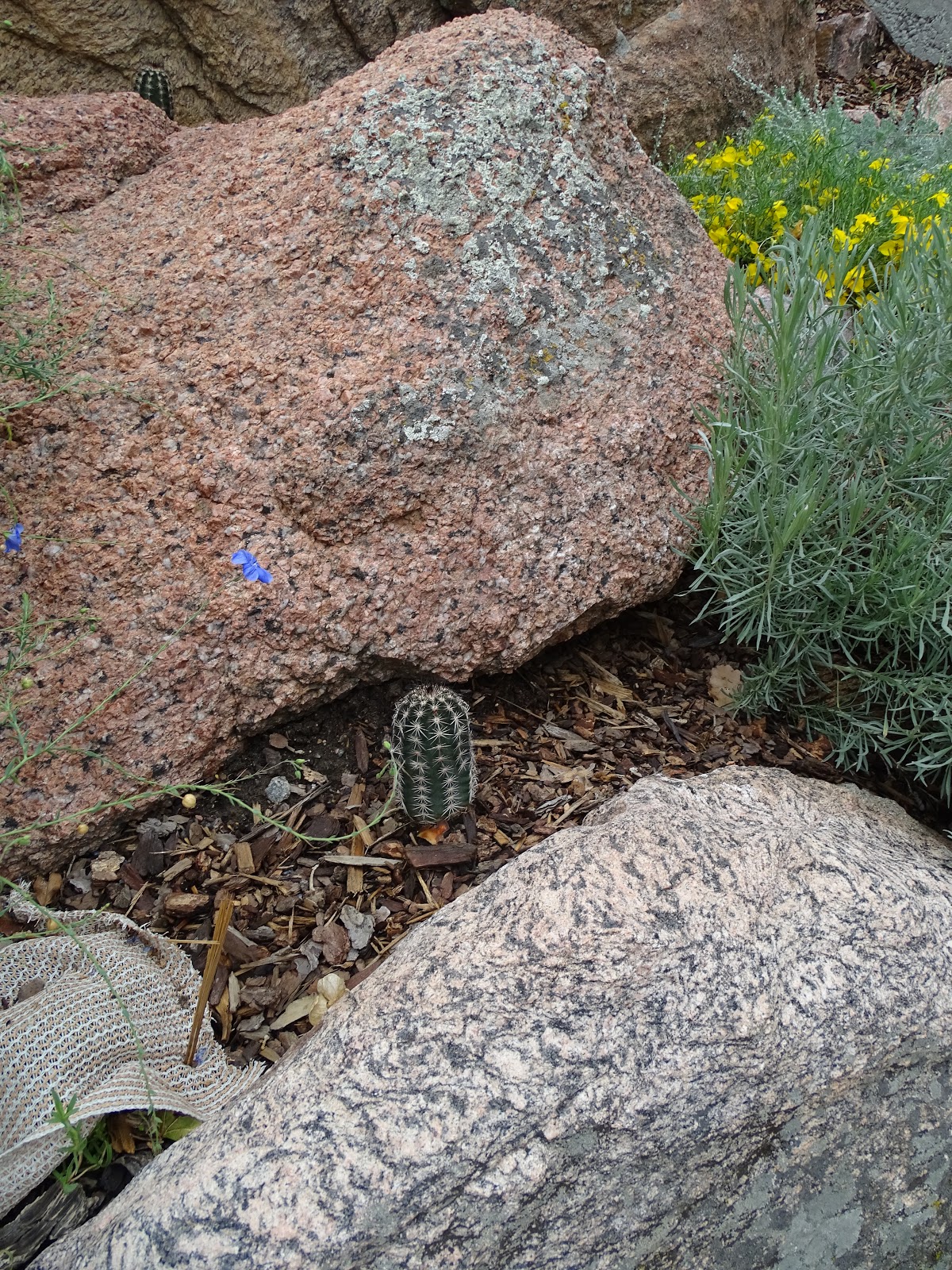
I love the contrast of delicate cactus and granite boulder. And I'm not sure what those washcloth thingies pegged down are--new plants?


Melampodium leucanthum, the incomparable blackfoot daisy that so often accompanies the zinnia in the wild, and blooms even longer. And which refuses to grow for mere mortals like me.


The simple geometry of rock, flowers, sage--it's sublime. The Japanese refer to garden effects like these (the gardens full of them) as Shibui (渋み)--a concept I find extremely appealing. Fourth time I've used that term in Prairiebreak.


I look forward to seeing the orange butterfly weed do its thing in future years!


The three leaf sumac (probably 'Lowgro' has begun to splay over the rock: talk about perfect positioning!


I'm glad they spared the foundation juniper--it fits right in!


Artemisia frigida complements the gray lichen nicely...Not your typical garden color combo--but Hey! We're in the West. Get over it!


I love the patterning on the rock itself...


Can't get enough of it: and  here's a little con-"cave"--cool as heck (only rock nerds will get it)...


We worked together for several wonderful years before bureaucracy intervened and this fellow pursued another avenue. An enormous loss for the Gardens. But we've kept up: I drop in on this amazing garden all the time: it's always perfectly groomed and I've never seen a weed. Such a relief to see this garden after miles of bluegrass and mediocrity in the 'burbs!


That pink saponaria was amazing: not sure which cultivar--but it wove through the whole garden!


I'm assuming this is Cardoon...everything looks so healthy and vibrant!


A monster Erodium chrysanthum: ours at the Gardens took four decades to get this big!


I love the way cacti interweave with perennials...this garden is proof you can have a rich, diverse plant palette (i.e., be a plant nerd) and have exquisite design!


I must drive by some evening soon when this giant Mentzelia is open (M. decapetala): probably the showiest plant growing on the Great Plains and I've only ever seen it in one or two local gardens!


Knockout beauty on the buckwheat--from southern Colorado (E. jamesii)


I can't begin to say how jealous I am of this stand of acantholimons: four or five species--self-sowing and simply stunning in seed. What a great contrast with the Zauschneria.


These didn't look like this very long. I harvested most of the seed (for the NARGS exchange--if you haven't joined NARGS, now is as good as time as any--and you might get some of the magic of these two fantastic gardens!)

Monday, July 24, 2017


From left to right it's Shannon Still, Steve Newall, Ed Snodgrass, Steve Still (Jr.) and Steve Still (Senior), Allen Bush, Pierre Bennerup, Thilo and Georg Uebelhart. Otherwise known as the Ratzeputz*  gang. Two members are missing (Dave Schultz and Kirk Alexander). Notably missing is Kurt Bluemel--who passed away in June of 2014.

I spent most of last week in the company of these delightful people: we visited the Bighorns, the Beartooth (proof is shown above--and you can even glimpse the "Bear tooth" in the background). We spent a day in and around Cody hiking behind the Retreat Center where we were staying and visiting the remarkable Buffalo Bill Museum complex in that town. Another day was spent in Yellowstone.

I've known and spent time with most of these Ratzeputzers on their home turf in New Zealand, Maryland, Kentucky, Connecticut and Germany. They've called upon me in the past to accompany them in Colorado. Needless to say, now that I've been inducted into their august company (several bottles of Ratzeputz were emptied in the process as initiation...), I can't resist but share my delight.

I know that fraternities have their detractors (I never joined one in College after all).  You may smile and tease me all you want--but I am more than a little tickled to have joined this illustrious clan!

Long live the Razteputz!

*Ratzeputz is a ginger based liqueur made in Central Europe and reputed to enhance health....it's an acquired taste, need I underscore. I'm developing a taste for it, much to my amazement!

Thursday, July 13, 2017

Desirable weeds?

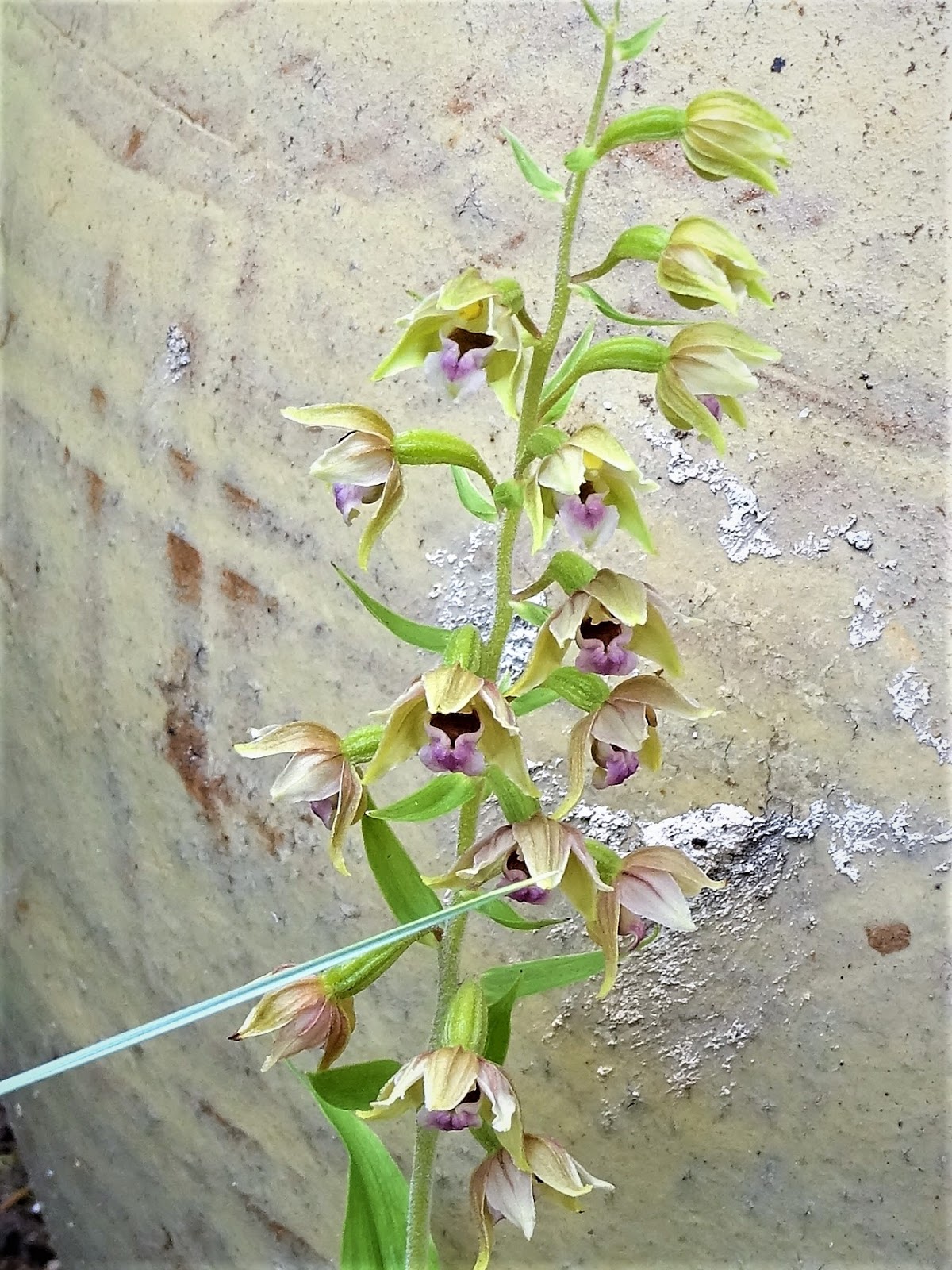
Epipactis helleborine

I remember first finding these in a meadow near Middlebury Vermont in 1973: I knew right away they were orchids, but couldn't imagine what Eastern species it could be...I discovered soon that they were the first Eurasian orchid to naturalize widely in the East. Fast forward a few decades later, and I saw some on the Hill in Boulder where I grew up--they'd managed to find their way to Colorado. Suddenly this year they appeared dotted across several score of feet in the El Pomar Waterway garden at Denver Botanic Gardens. I suppose if one is to have a weed, an orchid is a better case scenario. It doesn't really interfere with anything in this garden, and they are quite beautiful--if not the most colorful shades! I believe the horticulture staff may let them be...I'm posting a number of pictures so you can see the variety of form they take on...


Aha! Not at the Botanic Gardens now: this is Rod Haenni and Ann Priestman's wonderful garden in Bow Mar--and sure enough they had a rash of these appear (all but one of which Rod mowed down). He couldn't resist leaving one clump!


His is distinctly greener than the ones at Denver Botanic Gardens...


This is a different sort of weed: five or six years ago I spied Epipactis gigantea (our rare native cousin to the weed)  growing in some raised beds at the Grand Junction Orchard Mesa gardens. I asked them about the orchids and they said they'd appeared spontaneously! One whole bed was almost filled with them and they were weeding them out! I helped and weeded a few out--some of which were sold at Denver Botanic Gardens plant sales!

Here is a large mat of the Colorado Epipactis growing at Copenhagen Botanic Garden...


It certainly deserves the common name "chatterbox orchid"!


They also had large masses of Epipactis palustris, a European species that spreads rhizomatously but has not been weedy by seed (yet anyway). There are species in east Asia as well--a very interesting genus, I think. It would be fun to grow the less weedy species in a garden. And I know there are mail order nurseries that sell them. But you may get Epipactis helleborine soon in your own garden--even without trying!

Featured Post

Crime pays, gardens don't.

I apologize for "borrowing" Joey Santore's tagline--but it seems appropriate. And I think Joey would approve. What if I were t...

Blog Archive