Wednesday, July 31, 2024

A bevy of black beauties

Melanthium (Veratrum) woodii
Whenever a new species blooms in one's garden it is always a red-letter day...but a new genus qualifies as a black-letter day for me. Although Melanthium has been lumped into Veratrum by most workers, the Flora of North America still recognizes it. This is apparently the rarest of the four species in the genus: I would like to grow all four. Looked up close, it's delightfully sculptural and lurid, don't you think?

Melanthium (Veratrum) woodii
Found primarily in the Ozarks, it does occur in the Appalachians as well--although considered rare and sparse flowering. So I consider myself doubly lucky...now if it will only set some fat seedpods! By the way, I obtained this from Odyssey Perennials in 2018: so it bloomed in six years from planting--pretty fast in my book.

Melanthium (Veratrum) woodii
This is to show that this is not a plant for landscape impact. It's virtually invisible a few feet away. The foliage does look a lot like Veratrum, I aver....and it does have more than a passing resemblance to two black flowered veratrums that are blooming at the same time elsewhere in my garden. Coincidence?  By the way, notice I planted it cheek-by-jowl next to Gentiana lutea--much to my annoyance now....

Veratrum formosanum

I should bite the bullet and divide this: I've has several clumps for MANY years, originally purchased from Beaver Creek Nursery in British Columbia (which we all much regret its closing). Easily 15 years old.

Veratrum formosanum
The flowering is dense enough it's starting to bake a show! Albeit a rather glum and dark little show.
It never ceases to amaze me that a plant from Taiwan can be so tough and hardy in Denver!

Veratrum nigrum
And then there is the ultimate black flower: I have seen this wild in Eurasia. I have two clumps that usually bloom simultaneously, but this year only one stalk emerged. It blooms for a long season--and the seedpods are decorative as well. 

Veratrum nigrum
Worth growing for the foliage alone...

I am not the only one who loves black flowers--my friend Paul Bonine has written an entire book about them (Black Plants: can be found very inexpensively on the web).
 

Monday, July 29, 2024

A few glimpses of a Santa Fe gem of a garden

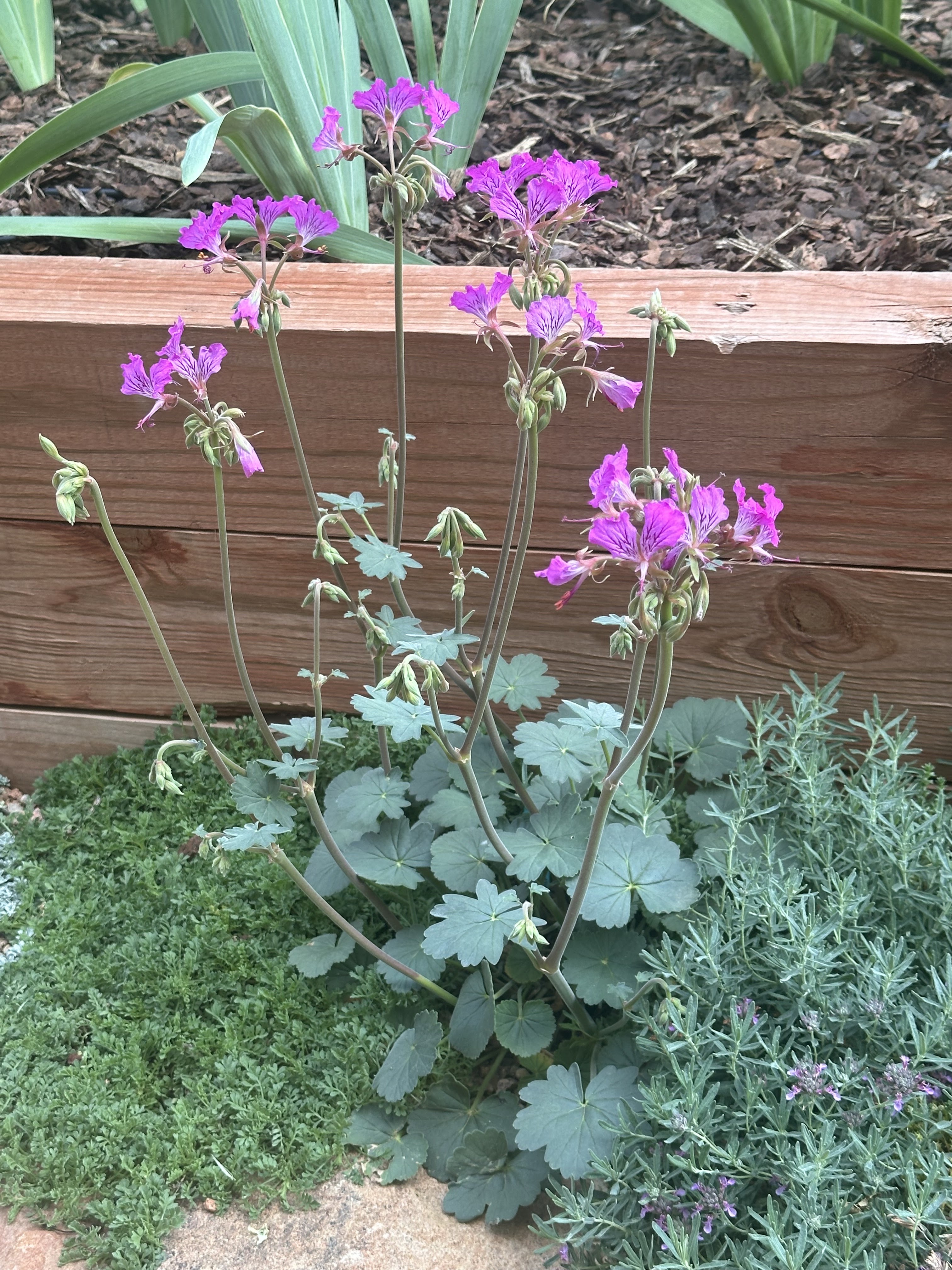
Pelargonium quercetorum

Our hosts, James David and Gary Peese, are two of the most passionate gardeners I know: James is a renowned landscape designer--and Gary is the master of the potager (not to mention a lover of tall bearded iris, dahlias and Japanese chrysanthemums--none of which were deigning to bloom for us during our visit. Their impeccably maintained garden (I was thrilled to find a single weed!) is primarily conceived of as a series of garden rooms designed for aesthetic impact (and of course the veggies and orchard trees are designed for the table), they have accumulated an astonishing range of rare plants that would be the envy of any mere plant nerd like myself.  The pelargonium above being emblematic: confined to a small area near Hakkari in Southeastern Turkey, I am sure not more than a handful of gardens in America can boast this giant of hardy pelargoniums.

don't have a clue what species of thyme this could be--but growing so compactly--and blooming in late July--I think it's one to seek out and treasure!

A delicious large monocot in bloom--I'm not even sure what genus it should be in. I wish I'd photographed the dozens of magnificent specimen cacti and rare bulbs that summer on a patio next to their greenhouse and cold frames.

A stunning blue hardy Agapanthus cf. campanulatus: possibly 'Wild Blue Yonder'? I wish MY agapanthus had this many flower stems!

Somehow James or Gary got a hold of the brand new Teucrium 'Harlequin's Silver' that was obviously well established well before the Plant Select program promoted the plant. They never miss a sale in Denver where rare plants are sold...the troughs around this are just a tiny fraction of their trough collections--all full of fantastic specimens.

This gives perhaps a bit of a taste of the wonderful plant combinations throughout the garden--the purple hybrid sedum on the far right echoes the Knautia macedonica on the left and contrasts with the yellow (dotted with scarlet) flowers on Hypericum cf. prolificum in between. There are hundreds of vignettes like this in room after room of this garden.

Pimpinella major 'Rosea'
I believe this is the rosy form of the scarlet Pimpernel--a striking cloud of rose pink in the border...

Late July is, of course, peak season for Asteraceae--Helenium and Rudbeckia here--sunflowers in general are the royalty or midsummer gardens.

Salvia cf. przewalskii

A lusty clump of a Chinese sage: this wafted me back to the eastern Himalaya where the salvias in this section occur in amazing variety.

The Koi in this pond are truly enormous...

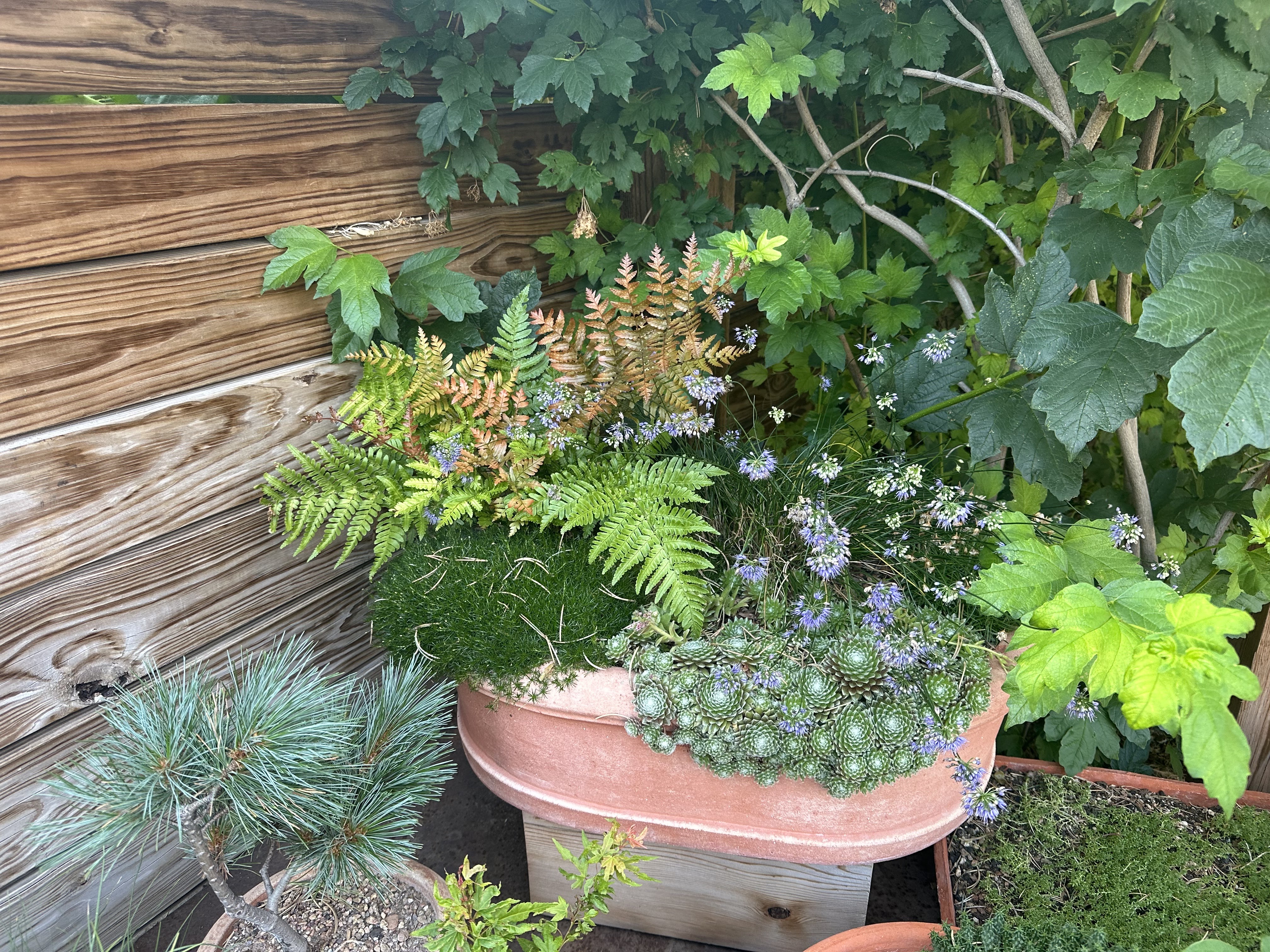
One of dozens of containers--the autumn fern (Dryopteris erythrosora) looking very happy [as it never does for me] along with a large clump of Allium cyaneum and Sempervivum.

More troughs--with Delphinium tatsienense in the foreground, and the OTHER hardy Pelargonium (endlicherianum) behind. James and Gary insist they're only focused on the big picture, on design, vegetables and large showy flowers (in Gary's case at least)--but they nevertheless have gathered and acquired hundreds of plant gems--many rare and unique--that thrive in the many microclimates or their garden! It's time they gave in and admitted they are consummate plantsmen as well!

Veronicastrum virginicum
A fabulous clump of Culver's root...

Verbascum chaixii (or a white form of V. nigrum?)

I am chagrined I haven't photographed the many mulleins (one of my favorite genera) that dot the garden: Verbascum olympicum is especially magnificent right now--but then I'm only showing a smattering of things I photographed randomly: I made no attempt to capture the many vistas and large combinations--the harsh light of mid day when I was photographing wouldn't have done them justice.

Lupinus polyphyllus

I love lupines, and admired the rusty red color of this specimen. 

Lilium 'Citronella'
The garden is full of lilies--mostly past bloom. But this graceful classic (which looks almost like a wild lily to my eyes--I love the species) is one I intend to buy and include in my garden henceforward!

x Mukgenia 'Flame'
I was delighted to see a thrifty specimen of this intriguing bi-generic hybrid between Mukdenia and Bergenia. I just realized my own has gone A.W.O.L. dammit!

Ephedra minima
I have never seen this Himalayan alpine joint-fir grown so elegantly. I am going to copy this!

Helichrysum trilineatum
A typical tableaux of foliage combos--they actually had several specimens of the South African curry shrub planted here and there in their garden--one of the most overlooked and useful Plant Select shrubs.

Escobaria sneedii var. leei (on left) and Austrocactus bertinii on the right

I tried to sneak this picture into my talk I gave last Saturday to the Midwest regional Cactus conference--and it showed up upside down (my punishment for last minute editing!). The glistening white escobaria is a very rare plant that only grows in Carlsbad Caverns in nature--but has proved a stellar hardy cactus across the country, but the Austrocactus has been a devil to tame (in my experience)...I finally found a little corner of my crevice garden where mine seems happy--but THEIR plant is much larger, happier and bloomed like crazy--in a POT! There is no justice...

I hope I have proved once and for all that in addition to being masters of hardscape, artful landscape design and so much more on the large scale, James and Gary are masters of the miniature and plant collectors par excellence! I feel so privileged to know them and have watched this remarkable garden evolve over the last decade! Some day, I hope I can post a blog that does justice to the big picture aspects of the garden: the fantastic trees, shrubs and massed borders--not to mention the most robust vegetables on the planet and Gary's pampered specialty mums, dahlias and tall bearded iris.

Tuesday, July 16, 2024

What on earth is Rindera?

Rindera lanata in the wild

 Boraginaceae are generally not at the top of most people's favorite plant family lists...That is if you aren't a lover of the steppes. We who belong to the "Steppe cult"* bump the family to the top of our favorites list--the variety and beauty of steppe borages must be seen to be believed...although this little creature belies the reputation the best borages have for flowers of piercing blue color. It's long on something else--namely it's cute as a bunny, don't you think?

Rindera lanata in cultivaton

And here it is in my garden: my OLD garden. I grew it there 35 years ago from seed I purchased from Jim Archibald--who collected it in Turkey. What is so cool about this plant is how it morphs as it grows...


It looks a tad different a week or two earlier than the shot before...but check out how it looks as it emerges from the ground:


I don't know about you, but any plant with a growth ball that wooly would be near the top of my list.

Alas, it did not persist at Eudora, and we couldn't obtain seed in Armenia. Who knows when and if we'll grow this again? I did obtain ANOTHER Rindera a few years ago that actually has showier flowers. Unfortunately, it is enormous. It came to me only as Rindera sp. from my friend John Rembetski...

Rindera sp. ex John Rembetski
Although it lacks the petite wooly charm of its congener, this is a striking plant nontheless. And perennial!

So now you know a little bit more about Rindera: Let me know if you find seed of these (or others!)


And you too can join the Steppe Cult!


Thursday, July 11, 2024

Crevice extravaganza in Cheyenne

Crevice garden in front of the Conservatory

There is a truism that it takes a city of a million or more people to support a public botanic garden. Like most truisms, this one fails the test! The Rocky Mountains are FULL of fantastic botanic gardens, some (like Steamboat Springs and Vail) in cities with little over 10,000 residents. I can think of dozens of cities with over a million souls without a botanic garden in America--but Cheyenne's 67,000 citizens support an outstanding institution you should visit (click on that link to find out more). And it boasts a kick-ass crevice garden that brackets the front entrance of a stunning conservatory. That garden is FULL of plant treasure. I blasted through briefly on July 5: here are just a few of the things I found.

Phlox nana 'Perfect Pink'

A truly superior form of possibly the best of all phloxes: why is it the best? It's extremely tough and drought tolerant (grows without irrigation for me). It blooms from spring to fall--so there! That counts for a lot! And despite coming from New Mexico, it thrives in Cheyenne--a city renowned for extreme temperatures, wind and hailstorms!

Eriogonum umbellatum 'Kannah Creek'

This accommodating buckwheat always looks good--but how often is it grown this artistically?


Looking here, you wouldn't guess that there were dozens of plants in full bloom: but the cushions, mats and rockwork almost obviate the need for flowers! Kenton Seth orchestrated much of the construction here as he has at a number of our leading public gardens. The igneous rock--which I believe is mostly a monzonite and granite--is a major departure from most crevice garden rock work.


Acantholimon cf. armenum

Prickly thrifts (my favorite common name for this genus) LOVE this garden: there are many species dotted about--all of them looking very happy.

Pterocephalus depressus

This wonderful groundcover from Morocco--basically an everblooming, prostrate scabiosa--was just coming into peak bloom in midsummer!

Eriogonum umbellatum v. aureum 'Kannah Creek'

More buckwheat: you can't have enough!

Rosa spinossissima

I have never seen the double form of prostrate Scotch rose before. I'm sure that's what this is..

Leontopodium alpinum

A picture perfect Edelweiss

Scutellaria resinosa

The flowering is just finishing--but even the seedheads are attractive on this little known native mint.


A well constructed crevice garden can almost dispense with flowers--the varicolored  mats and buns are so attractive knitting the rocks together!

Teucrium aroanium

I am surprised a plant from the Peloponese in Greece should be so hardy in Cheyenne: I know this doesn't get subzero temps where it comes from! By the way, I have blogged (irritably I should underscore) about this plant before. Click here if you like to read rants.
 
Acantholimon sp.

Yet another Acantholimon...

Acantholimon sp.

And yet another Acantholimon...

Euphorbia spinosa 

I know this looks like a green blob--but it is a lot more than that. This compact mound (mostly restricted to France and Italy) is studded with myriad yellow blooms in Spring. And it is ironclad drought tolerant!                                                                                                                                                
Erigeron sp. 
A miserable picture of a cool Erigeron I found a few days later in the Bighorns--I have got to key it out (I have it in my garden too!)

Arenaria alfacarensis

One of the tighest of all cushion plants--from Spain.


More longer shots of the garden--notice how the phlox is spreading. It likes it here!

Eriogonum jamesii

Our local buckwheat again: it gets much showier in a few weeks...

Allium lusitanicum

This allium has been banned from my garden: I hope it won't be weedy here!


Get a load of that Acantholimon!

Acanthus balcanicus

I would not have expected an acanthus to grow in zone 4 (although the locals would have you think it's Zone -12)

Acantholimon halophilum, Eriogonum kennedyi and Heterotheca jonesii

Three gems jostling with one another...

Monardella macrantha 'Marion Sampson'

I've had several very good gardeners tell me this hard to grow for them...obviously not for Cheyenne!

Kniphofia hirsuta
My favorite dwarf 
Eriogonum jamesii, Heterotheca jonesii and Globularia stygia

Solidago sp.

 Mind you, these photos were taken mid-summer: imagine this garden at the height of spring! Although I have to admit that I find it delightful any time of the year including wintertime! Those cushions, mats, contrasting rocks and the delicious Wyoming light make it a feast for ever season.


Better yet, plan to visit yourself--why not join us next June. I can assure you this meeting will be off the charts!


Featured Post

A garden near lake Tekapo

The crevice garden of Michael Midgley Just a few years old, this crevice garden was designed and built by Michael Midgley, a delightful ...

Blog Archive