I'll get around to White's biography of Proust in a bit--but this unusual blog post is really an attempt to gather a few thoughts together that have been scampering around my brain, much the way a dozen or so kid goats might scamper around you if you wandered into their enclosure. I suspect my thought process I will describe here is probably rather similar to what many of you experience ongoingly: a series of experiences (going to the movie, watching an opera, going to an art gallery, reading various books and articles: all of these played a part in this essay) have coalesced--or rather--elements of all these experiences have reflected upon one another to provide a sort of insight which is (in my case) that perhaps we haven't progressed as far as we think we have. That may not be a bad thing. Or is it?
The impetus for this blog was watching Steven Spielberg's production of ...
West Side Story last night with Jan at "the movies". Who hasn't seen the original movie of 1961? For some of us on the verge of our teens, watching this was as profoundly searing an experience as
Psycho had been a few years earlier (yes, I saw that as a pre-teen: there were no ratings back then and kids were exposed to all sorts of things--rather like computers nowadays).
The extraordinary romance blended with violence and blatant racist overtones were a heady mix for a kid: but the very mood and patina of film--not too far removed from the stage performance in some ways--imprinted itself on me. I'd re-watched this movie several times over the decades: it seemed so perfect an object of art I never would have dreamed anyone would think to "remake" it. Would you remake "Groundhog day"? I guess they have done re-treads of "Ghostbusters" (God forbid). I admit I was shocked when they remade "The Producers"--the second version is extremely watchable (I may even have a DVD of it) but get real--who could ever surpass Zero Mostel and Gene Wilder? Mel Brooks' skill as director and producer had grown enormously over the nearly 40 years between these productions--but part of the charm of the earlier movie may have been its lack of studio polish--just as the original "West Side story" resonates because it's basically a Broadway Musical shot in the real New York.
The problem with modern remakes is that they cater slavishly to fancy screen effects:"Star Wars", "Lord of the Rings"--hell, every goddamn film over the last decade or two is so lavishly computerized, whiz-banged with over the top cinematography that little things like plot, story line, theme, character and substance are glossed over in the process. Spielberg is perhaps the uber-meister of artifice in movies. The actors in this remake of West Side Story are superb, the dances are so spectacular they'd make Busby Berkeley blush, New York's slums and vintage cars are realer than real...the incredible cinematography, the over the top everything almost smothers the story line at times (and that's not easy to do with this story). Almost is the key word: I was glad I saw it. When all is said and done, I'll stick with the earlier version thank you. They told us it employed 15,000 people to make this reduplicative and second rate film. That's not progress in my book.
And so it is with so many facets of our so called modern life. A leitmotif that weaves through so much that I see, read, experience and observe is that we have propelled ourselves a little ahead of where we ought to be: we have sold our selves wholesale to rampant change, technological gadgetry, convenience and what not...but what I wouldn't give to exchange a few weeks of life today for a week or two in the fin de siècle, la Belle Epoch, namely the late Victorian era--but in France. Which I suppose is what I've basically done in the last week or so by some other excursions.
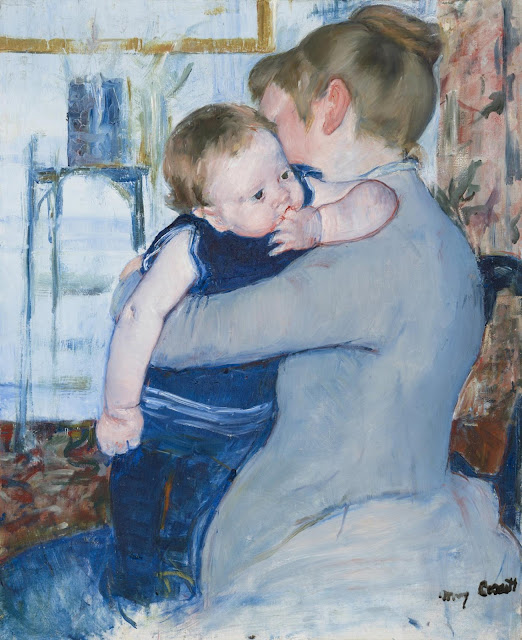 |
| Mary Cassatt "Mother-and-Child" |
The Denver Art Museum stages no end of "blockbusters" and the current exhibition "Whistler to Cassatt: American Painters in France" is outstanding. Of course, seeing large numbers of Cassat, Whistler, but also Sargeant canvases is in itself a pleasure, but I was amazed to see how many other Americans studied at the salons in Paris and produced exquisite paintings: there had to be well over a dozen names I'd never heard of. Looking at so many wonderful paintings, and reading the well curated program of the exhibit that almost transported you to the late decades of the 19th century gave me a sense of the fantastic sophistication that prevailed at that time. Reading White's biography of Proust of course underscored this lesson...*
 |
| Metropolitan Opera H.D. broadcast of Jules Massenet's "Cinderella" |
A week ago today (it was on Saturday, New Years day we attended the Met Opera H.D. live opera broadcast of "Cinderella" (the photo above captures a smidgeon of its whimsy). For those of you who don't go to those productions, more's the pity--that's real progress! Honestly, the thought of watching an opera of an old fairy tale wasn't something I'd yearned for--but I've learned that anything the Met does is worth the ridiculously modest cost. We and our friends had a whole theater to ourselves! The production was brilliant (so brilliant that one overlooked that the fetching Prince Charming was a woman). So here technology succeeds--but what echoed in my mind was that this was the music of La Belle Epoch! This reinforced the fantastic renaissance of painting, music and writing (here we adumbrate Proust!) at a time of magical cultural florescence!I know that life in the late Victorian era was more than a bit tawdry and that there were no end of social, political, and other issues faced by people in America, Europe and their myriad colonies. Museums and Universities are busily focused trying to somehow clean up the moral, ethical and social consequences of that colonialism, which a piece of my socialistic heart sorta believes in.
I wish they'd focus a bit more on how that period was able to produce artists like the great French and American impressionists, like Messenet and the late Romantic composers of Germany and France and especially like Tolstoy, Dickens, Flaubert, Pérez Galdós and ultimately Marcel Proust in the realm of writing. The last half of the 19th Century saw perhaps the apogee of discovery in Biology and Geology in the realm of Natural History. William Robinson and Gertrude Jeckyll (and their European compeers) more or less invented ornamental horticulture as I practice it today.
My epiphany has come about rather slowly, partly due to reading the essays of T.D.A. Cockerell (Colorado's greatest biologist) who grew up in Victorian England (I reference these in a previous blog)...Cockerell (who was close to and worked with Alfred Russel Wallace) acknowledged his profound debt to William Morris and John Ruskin.
Reading White's superb biography of Proust, Ruskin's name leaped out at me again: Proust translated two of Ruskin's seminal books (the originals of which in Victorian bindings are sitting on my shelves). I realized reading the biography, steeped in the milieu of movies, exhibitions of late 19th century art that the Arts and Crafts movement was NOT a dusty, dismal faddish obsession with wall paper and oaken furniture. Ruskin and Morris were major architects of the Social transformation of Great Britain from an absolutist, aristocratic Monarchy to the Socialist, far more egalitarian Constitutional government Britain was to become in the 20th Century. Ruskin and Morris have risen to the top of my must read list.
The extraordinary Aesthetic renaissance of la Belle Epoch (equal in my mind to the Italian Renaissance in music, art and especially Literature) represented the outward expression of a seething philosophical ferment among aestheticians and social thinkers on how to create a society for everyone that was commensurate to the extraordinary art of the few.
We are the heirs of that era: I find myself looking back more and more to them for inspiration and insights. I wish we'd remake, retread and recreate (not literally or slavishly of course) the extraordinary blend of art, science and social consciousness which they perfected. And which we have not.
Progress is not a linear thing I fear.
*If you live in the Metropolitan area (or even beyond) do make a point of seeing this exhibition at the Denver Art Museum it will be on until March 13.