Saturday, December 18, 2021

Succulents RULE! Patagonian cacti and more....

Pterocactus araucana (Laguna Blanca)

I have been a life-long lover of succulents: much of my claim to horticultural fame comes from introducing hardy African succulents to general cultivation after all. But I've always had a soft spot for what Reginald Farrer called "fattened little columns of hate"--namely Cacti. Imagine my delight in seeing several genera for the very first time in nature! In BLOOM no less. The bronzy, brassy, coppery color of Patagonian cactus flowers is unique and mysterious...a highlight of a magical trip there I just returned from.

Pterocactus sp. (Laguna Blanca)

With a simple elegant form like this, who needs flowers? What a bold, elemental presence. Oh to have this in a pot or better yet in my garden!

We found dozens of these in one meadow, so variable in form....just one crazy species or a few possibly hybridizing? Such are the mysteries of field work. I do love to travel, I confess.

Austrocactus coxii

You can imagine our amazement and delight when we found this monster clump in full bloom! You can imagine all eight of us lined up to photogaph it...

Austrocactus coxii

So similar in so many ways to our North Hemisphere Echinocereus--but alas, not quite so indestructible...I planted a dozen of these in the last two years and they disappeared within weeks: I wonder if my rabbits ate them? I became paranoid--theft? (they were not obvious--no one could be that devious)...in the future, I will only plant them under cages!

Austrocactus coxii (A closeup of the exquisitely colored flower)

Austrocactus coxii

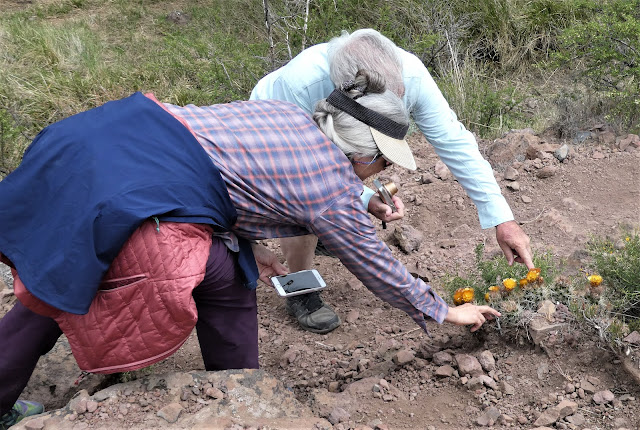
We're so rapt we even have to TOUCH them!

Austrocactus sp.
 
On a steep canyon someone spied another lurid flower, and of course Rod Haenni (our intrepid trip leader) had to get up close and personal!

Austrocactus sp.

Believe me, it's steeper than it looks. Clumsy, cautious, life-loving me never GOT a closeup [do you think my good buddy would share a lower resolution photo of this form for you to see up close? We shall see...check back in a few days]...

Austrocactus sp.

Patrice Van Vleet had to go join in the daredevil act...I believe her husband had excellent life insurance coverage on her, so it wasn't as serious as it looked!

Austrocactus bertinii (Picaniyeu steppe near Bariloche)

Yet another Austrocactus we found in bloom not far from Bariloche on windy, dry steppe--a delicious caramel color this time! In yet a different habitat!

Austrocactus aff. hibernus (Laguna Epulafquen)

Our last day, before we flew out (and after we'd had a flurry of worry over antigen documentation--another story that!) we saw this on our very last stop headed back to Chos Malal. Eagle-eyed Marcela Ferreyra caught a glimpse of the bronze blossom out of the corner of her eye as the car sped by.

Austrocactus aff. hibernus

We found dozens of plants--many in bloom! You can't imagine the group scattered out here and there in ecstatic delight. What a fantastic way to end a trip! (By the way, don't try saying Laguna Epulafquen ten times quickly--you'll regret it. I tried).

Maihuenia poeppigii (near Primeros Pinos)

The most amenable of South American cacti for the garden: I've seen this thriving in gardens across North America and Europe as well. But to see it in full bloom in nature...that's why we live.

Maihuenia poeppigii

Get a load of the size of that monster. I had to pause and count my lucky stars.

Maihuenia poeppigii

The fellow at the far left taking the picture is none other than Steve Brack, founder of Mesa Gardens. I don't think there is an enterprise on earth that has done more for the preservation of cacti in the wild than his nursery (which he sold a few years ago in order to have a chance to travel more). He provided seed very cheaply of thousands, perhaps ten thousand kinds of succulents for decades-obviating the need for wild collection). lf there is such a thing as a National Treasure, he would be my first nomination.

Maihuenia patagonica

Growing at lower elevations, we encountered the much more widespread and variable M. patagonica several times--a few even with lingering blossoms.

Maihuenia patagonica

Most, however, were forming their tubby little seedheads. Strangely, I have not found this as easy to grow as its alpine cousin. Seeing it in the wild has spurred my desire to try it again!
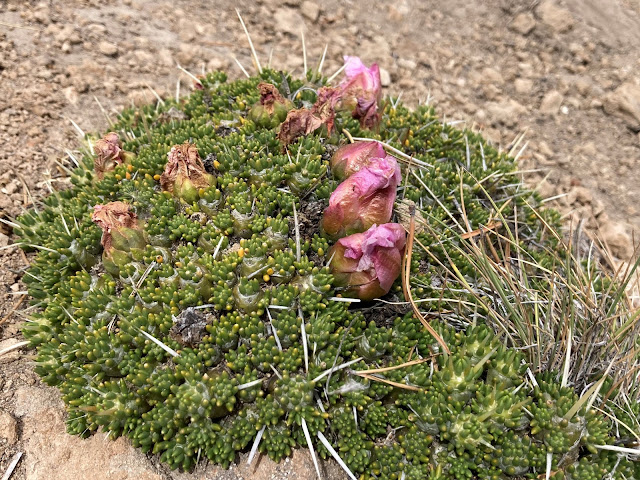
Maihuenia patagonica

One, and only one plant had a pink blossom. It was very windy and overcast: OH! to have gotten a picture of it open. Better yet, to have clumps of this in my rock garden! Something to dream about!

Maihueniopsis pteracantha

There was more! I'd seen Maihueniopsis species in Chile twenty years ago, but not this one! Get a load of those spines!

Maihueniopsis pteracantha

Rod has grown this for years, and says it's very slow. It's well established in cultivation but not, alas, in my garden....yet.

Maihueniopsis darwinii

It was a bit overcast when we found our first M. darwinii: well established in cultivation from Rod's collection decades ago. What a treat to see it if only in bud. And we saw it again and again later on!

                                                                                                                                                                   The North American Rock Garden Society inaugurated Internet Webinars not long after COVID set in last year: this will be the fourth and the very first ever on the subject of succulents in rock gardens! Click here for more information about it! Succulents have been taken for granted far too long by rock gardeners. What plants provide more color than Delosperma? What plants endure more drought or provide such reliable year around impact? What other plants have such sculptural diversity of form?

The lion tamers and organizers!

 The vision of this Webinar is to demonstrate how great gardeners from the four corners of North America use succulents outdoors in gardens, and which ones have adapted for them: you can be sure a wealth of plants will be shown, and exciting ways to manage them wherever you live! There's more to succulents than a few weedy sedums, some hens and chicks and a prickly pear after all! Let's fill in the gaps!

                                                                                                                                                                 Amanda Bennet has created both the rock garden and an ambitious cactus and succulent garden at Atlanta Botanic Gardens where she is now Vice President. Amanda has found an astonishing range of cacti, agaves and other succulent gardens that tolerate both Atlanta’s hot humid summers and often rainy winters

Lori Chips
THE book on hypertufa containers by Lori Chips!

Who can’t fit a trough on their balcony or patio? Succulents thrive in troughs—and this indisputable queen of “Troughcom” (she wrote the book on it!) will demonstrate the techniques she’s used for decades as the Alpine specialist at Oliver’s nursery in Connecticut

Jay Akerley grows a wide spectrum of succulents in rainy Vancouver, but also on the frosty heights of Canada’s mountains where frost can occur in any month. He’ll share his strategies for success, as well as the range of toughies that will take both mild winter rains and arctic blasts of frost.
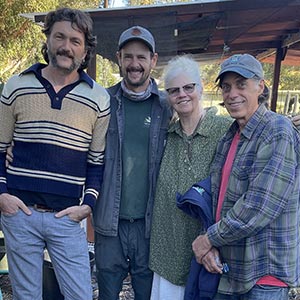
Kiamara Ludwig, Russell Wagner, Walker Young, Brian Kemble are all horticultural professionals with deep history in East Bay area public gardens. They have combined their talents to test a wide pool of plants at the public crevice garden at the Gardens at Lake Merret in Oakland’s winter wet Mediterranean climate.

Vince Russo has created one of the most beautiful rock gardens featuring a wide range of Western American cacti which he has combined with classic alpines and an increasing range of African succulents in the suburbs of Detroit. If he can create one of America's most exquisite succulent rock gardens in Detroit, you can where you live too!

Rod Haenni has experimented (and succeeded) with a wider range of Zone-5 hardy cacti and African succulents in his gorgeous rock gardens than anyone in North America. As Vice President of the Cactus and Succulent Society (and long time member of NARGS) he’s helping pool and bridge the expertise of both specialist groups.
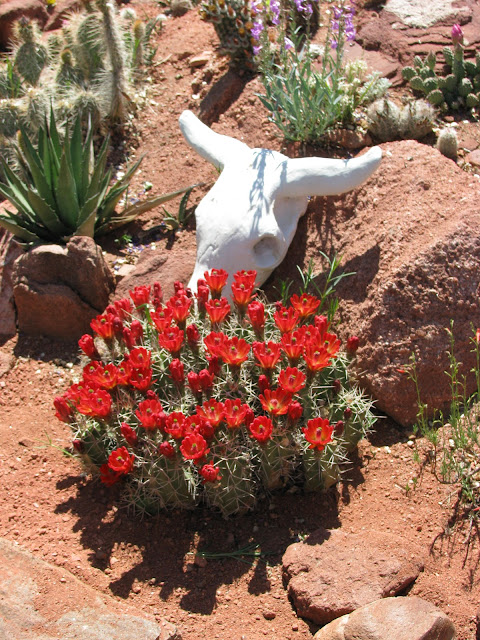
Echinocereus coccineus in Barnett garden, Pueblo, Colorado

 Do join us this January 15 for the first ever Symposium on hardy cacti from the four corners of North America. don't worry--you won't be expected to add skulls to your garden. That's optional! Missing this isn't!


Wednesday, December 15, 2021

An explosive exposé of futher exploits! Violet alert!

Courtesy of Nicholas Elguero (https://www.researchgate.net/figure/View-of-the-volcano-Copahue-during-the-onset-of-the-December-2012-eruption-The-Villa_fig3_300471299)

 I stood at the very spot this picture was taken (see below) fortunately not when that picture was taken, however, in December of 2012: several important things to note: that was a very snowy year. My picture below was taken at the same time of year--note the absence of snow. Argentina has been undergoing an extreme drought much like much of the Western USA. But this blogpost has other fish to fry (so to speak), or violets to pluck as the case may be!

My picture taken on December 7 this year...at about 10AM if you must know.

 Do look back and forth between these two shots, taken exactly 9 years apart. Not only is there a radical difference in the amount of snow, just look how the city of Coviahue on the lake front has expanded! That brings something else to mind...

Don't move past this picture too quickly please! I know the large, seemingly empty plot of ground before you looks unpromising: mostly bare "dirt" as they say, and lots of red stuff (Rumex acetocella--or sorrel if you prefer: one of the most astonishingly Universal weeds throughout Patagonia growing literally by the trillion). But please note the white post that's slightly above and just right of center: THAT will be showing up again...below as a matter of fact!

That very post!

Verily I say unto you that's the very same post you saw in the third picture I posted. But it's not the stick I want you to note...look towards the bottom of the picture...let's take a closer look!

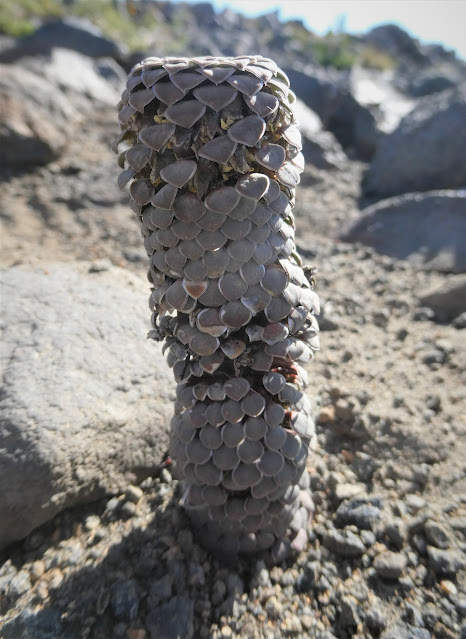
You might think it's a Lithops at first blush, or some strange spineless cactus like Blossfeldia or Aztekium or maybe even Epithelantha? Wrong on all counts: check the next image for a better view...


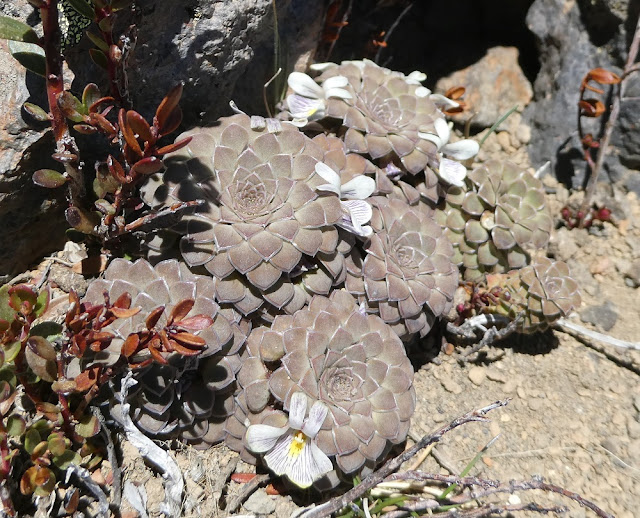
Here it is looking from the vantage point of the post! The Fibonacci symmetry of revolute leaves should give away that this is none other than one of the quasi-mythical rosulate violets that rock gardeners in particular dote over. Violets grow the world over, but only in South America, and more especially on and along the foothills of the Andes are where dozens of species occur--many of them excruciatingly rare and tantalizingly hard to find. What THIS picture doesn't show is that the seemingly vacant lot beyond is chockablock full of the little munchkins!

I'll be showing you a selection of the violets growing here--but notice the strange object on the right--a tip of Araucaria branch...see below


The very same plot of land looking towards the mountains on the left, where a fantastic forest of Araucaria araucana soon commences--a few stragglers have remained in Coviahue--who knows for how long? Notice my companions to the right: I imagine the eight of us probably took many hundreds of pictures in this doomed little piece of paradise (philosophizing left to the end): now--just sit back, or rather, just scroll down at a random series of pictures of Viola pachysoma--one of the most remarkable creatures on the planet!

Not sure why this one has multiple heads: perhaps it was stepped on as a child?

Most are brownish in coloration, but quite a few were sea-green like these...wonder why?

I was fascinated by the tall ones like this: this used to be lumped with Viola columnaris--a species found in different habitats a ways from here. I like that name better than "fat body" which is what pachysoma is in Greek.

There were dozens of clumps like this all over the plot of ground...or should I say plat? It is apparent that this whole area will soon be wall to wall condos, hotels, shops--you name it. Anything but wildflowers. We did see this violet at quite a few other locations, including on the volcano above the town of Copahue where it was still in bloom (these were all going to seed--little balls tucked between the fat little leaves). I'll end with some of the ones we found blooming to cheer you up!

I may have shown this one in the blog I did a few days ago about the amazing hybrids between Viola pachysoma and V. cotyledon that occur in these parts of Patagonia...I still wonder if it doesn't have a little "V. cotyledon" genes in it--the flower is a bit big..

This one is more like it: I realize that ski towns all over the globe obliterate wonderful wildflowers in order to accommodate us humans. I think we've gone way too far! I was extremely impressed with the magnificence of Patagonia--steppes and mountains both! And the wise, kind people. Their extraordinary ski towns reminded me of Steamboat and Aspen--only DECADES ago. COVID has perhaps stalled the inevitable Californication that's smearing so much of the Rocky Mountain and Intermountain region with the second and third homes of plutocrats, endless condos. I-70 in Colorado occurs to me as a sort of interminable strip mall...

Naussavia lagascae

Gotcha! Not a violet at all, but a sublime daisy (it even smells like chocolate). You can see a sort of parallel evolution going on here (this was a stone's throw from "fat body" violas..)

We never knew the Glacier Lilies that were extinguished when Steamboat or Park City or Sun Valley were developed. Or any of the other hundreds or thousands of species that gave way so humans can speed over snow on parallel sticks. 

Wouldn't it be wonderful if instead of plunking yet another ticky tacky building on this still vacant lot, instead what if they turned it into a "Rosulate" park, with board walks to be sure the tourists who flock here in the future don't trample our little treasures...

The likelihood is infinitely small... but I toss the idea out there, into the ozone! Perhaps some day far hence some young Argentines will read this blog post and think "I wish our Grandparents had listened to that old gringo!"


Trouble in paradise: a monkey puzzle perplex!


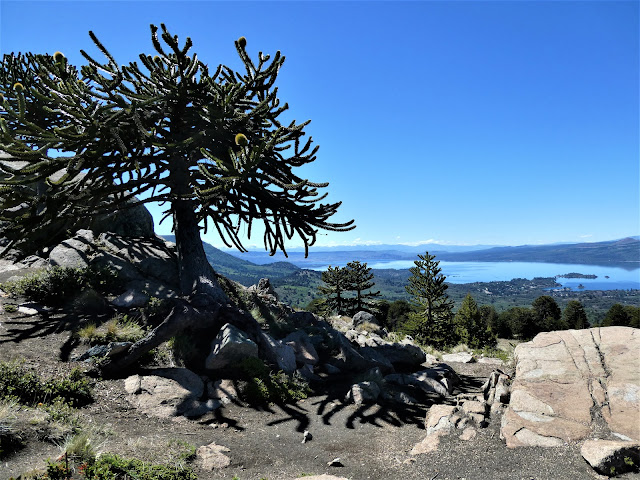
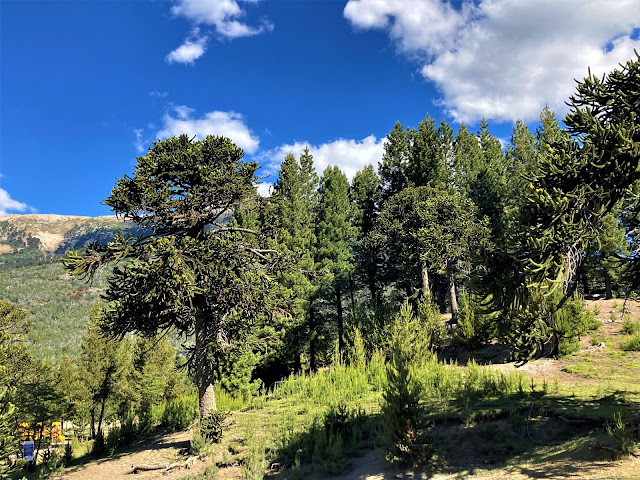
Araucaria araucana on Batea Mahuida volcano

At first you aren't really perplexed: these outlandish trees are simply magnificent, and here at tree line more than a little awesome (to use that poor abused word in an appropriate context). You simply can't stop admiring them!

Here I am with Marcela Ferreyra--the extraordinary botanist who led our trip: if you ever have a chance to travel with Marcela, take it!

But don't let me distract you from these amazing trees. They don't just look like they lived in the Cretacous, they look as though they borrowed the armor from the dinosaurs that munched on them!


I could post dozens--maybe even a hundred or more--pictures of the Araucaria forest: it's enchanting and every tree seems to demand "take a picture of me you silly mortal!"

Here's another one!

The enormous roots are hugging a giant rock in this shot like hungry pythons.

How about this bonsaied specimen I dare not show Larry Jackel (my bonsai-master colleague at Denver Botanic Gardens) who would have demanded I dig it up and bring it back. I suppose if I were Elon Musk I could get away with it. Or Mr. Facebook who gets away with even more.

Marcela Ferreyra--intrepid tour leader--took a picture of ME taking the last picture: proofo positive I was there!

I promised you trouble: there it is. Everywhere in Argentina there are vast plantations of lodgepole and ponderosa pines. Just what a Coloradoan wants to see--the two most abundant trees of his back yard. Makes you almost ignore the volcano in the distance.

Here you can see an Araucaria swamped with masses of lodgepoles. I can't begin to imagine how these will impact the scenery (or worse, the actual monkey puzzles). The trees are still relatively small--but soon will be full of cones.

The dazzling effect of the native forest is already muffled in many places--just look at the seedlings in the foreground! What a disaster in the making. Argentina and Chile ban the export of even a single Araucaria seed--but meanwhile they're doing nothing (or worse, they're encouraging) exotic pine plantations. I was told many were funded by well meaning "carbon-credit" schemes. Talk about unintended consequences!

I finish with a few very different shots: these are pines spreading onto dry steppe: I don't know how the hell they grow there! But we passed countless mile of rich steppe vegetation that is being replaced by a sterile monoculture of pines (with nothing underneath).

Of course we saw lots of exotic flowers like lupines, california poppies, scotch broom and the entire spate of Eurasian and American weeds like Erodium cicutarium, Verbascum thapsus, Capsella bursa-pastoris, dandelions--you name it. The herbaceous plants however ubiquitous (the common storksbill had to be at every stop we made) and however gorgeous (the broom was really dazzling), altogether don't have a fraction of the impact of the rampant, hideous and frightening spread of alien forestation there.


Featured Post

Crime pays, gardens don't.

I apologize for "borrowing" Joey Santore's tagline--but it seems appropriate. And I think Joey would approve. What if I were t...

Blog Archive