|
Military Macaw Ara militaris (photo by Mark Amershek)* credit at and of article
|
On my November escape to Puerto Vallarta I had the good fortune of meeting Neil Gerlowski--an inspired horticulturist via our mutual friend Mae Lin Plummer. Mae Lin assured me I would take to Neil: who epitomizes so much I respect in Americans. Neil served for nearly 10 years as the executive director of the Vallarta Botanical Gardens and now conducts all manner of adventurous and nature tours through his business Ajolote Adventures (www.ajoloteadventures.com). I'm so grateful he had time to cook this one up for us on short notice.

I have visited many a sanctuary in my day, but none can match the story of THIS one. It was created by a remarkable man (Francisco Espino Ibarra) who was devastated when poachers cut down a giant pine on his property to steal the chicks of the Military Macaws nesting in it. Francisco and a team of volunteers cut out sections of the fallen tree that contained the nesting cavities and mounted them on nearby trees and were delightfully shocked when the macaws returned and roosted. With the help of friends, family and fellow nature lovers he then devised and mounted artificial nesting boxes (which you'll see later in this blog) and now has 30 pairs of these incredible birds nesting in his expansive reserve, el Santuario de las Guacamayas. (You can read more about the reserve here)
 |
Military Macaw Ara militaris (photo by Mark Amershek)
|
The Military Macaw is so named because its predominant green color resembles army uniforms in some of the countries where the bird lives. Although not technically endangered, the numbers of this macaw in nature have plummeted over the last few decades due to 1) poaching: the bird sells for fabulous sums to parrot fanciers--many of whom will pay thousands of dollars for stolen birds: a fabulous sum for poor local farmers) 2) their preferred nesting sites are old growth forests--which have been lumbered to a terrifying extent in the last century. The small trees that come back from habitat destruction cannot provide the large cavities the birds require.
 |
Francisco Espino Ibarra (right) and his son Yamil (left)
|
This is THE MAN. Who together with his son (seen behind) have dedicated their lives to this wonderful project. His tee-shirt reads "Simply distracted by birds". You realize after spending even a few minutes with this man that his dedication is profound. The effort he and his family expend on behalf of the macaws (and the entire large piece of land they collectively manage) to preserve and protect it was truly humbling.
 |
Military Macaw Ara militaris (photo by Mark Amershek)
|
What an enchanting bird! But what an amazing story! They receive no government support for their efforts and were able to fund and support the reserve entirely on donations by visiting birding groups--a funding source that evaporated with COVID-19. Being subsistence farmers, they've survived and persisted--and hopefully the tours will return and perhaps a benefactor may come to help....one can only hope!
A photograph of one of the dozens of nesting boxes on the Espino property which they carefully monitor and keep free of potential hazards: they climb the trees and check on the chicks and have made extensive observations on the life history of the birds. It is inspiring to hear Francisco describe the food preferences, the nesting habits and the complex life history of the birds: his passion and delight in them is utterly infectious and inspiring.
 |
Military Macaw Ara militaris (photo by Mark Amershek)
|
It is astonishing to see clusters of these birds like this--which one does all over the reserve!
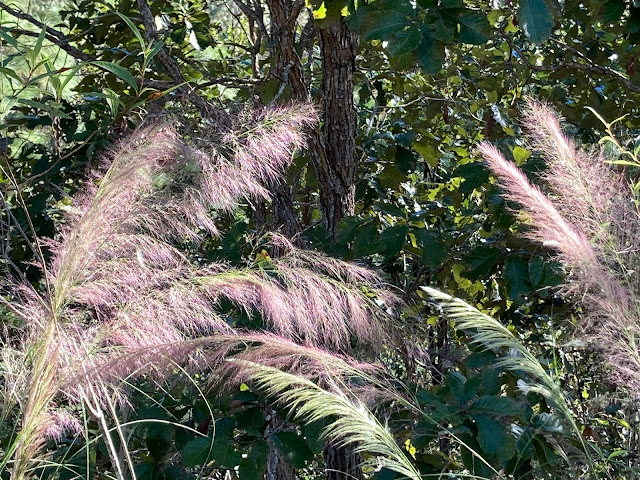
As a botanist, I was riveted by the amazing flora of the Mexican tropical pine-oak forest: at least four species of oak and several species of pine (a combination so common in our cold temperate forests) occur here where frost is unknown. There were fantastic plants at every turn! Like this spectacular Muhly grass (not sure of the species--I will be sharing this post with a Mexican botanist, who I hope can provide specific names for the plants I don't know).
I do love all Muhlenbergia! This is quite similar (and possibly conspecific) to some from Texas that are grown in warm temperate gardens...but seeing them in the wild is much more fun!
And yet another shot!
 |
Aechmea sp. (novoae?)
|
This wonderful bromeliad grew all over the reserve--many epiphytically but also terrestrially...
 |
Miconia vallartensis
|
I was surprised to find something that looked suspiciously like Tibouchina: unfortunately only in early seed. Since there are hundreds of species in Mexico and Central America...
A crustose lichen similar to what we have on granite in the Rockies...
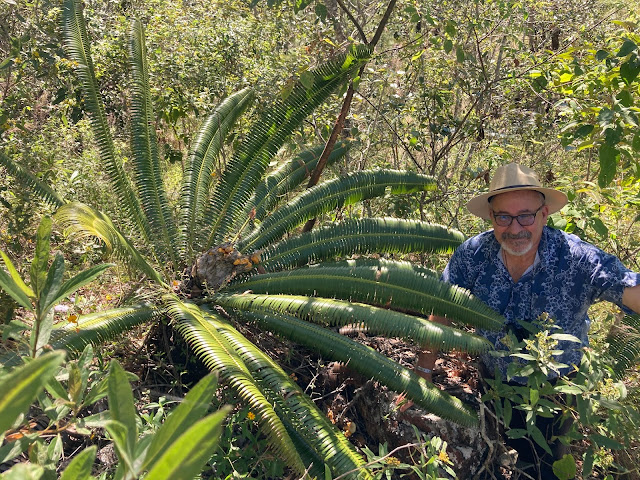
There were two species of cycad on the property--lots of Dioon tomasellii on the property. As with the macaws, these have suffered depredation from unscrupulous collectors. If you check out the spotty range of the genus in nature you realize how vulnerable these are.
 |
Cuphea hookeriana or jorullensis
|
I am pretty positive this is a Cuphea: and quite a showy one. All my internet sleuthing couldn't come up with a specific epithet, but perhaps my local botanist will come through with a name: check back in a week or so!
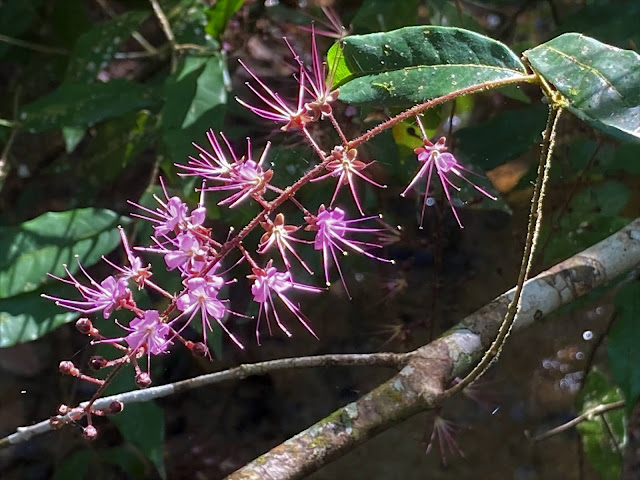 |
Hirtella racemosa
|
Another marvelous mystery plant...
 |
Habenaria floribunda
|
I was stunned to find a terrestrial orchid that resembled our Colorado native Plantantheras: hopefully these pictures will be good enough for an I.D. (I subsequently got confirmation for this name from my good friend Scott Smith in Denver, as well as Ana Nuño Rubio).
One of the remarkable constructions on the site for viewing: this place is simply amazing!
Another shot of the Aechmea...
 |
Clusia salvinii
|
Neil harvesting leaves of a Clusia which Francisco informed us is often blended to make a medicinal "agua fresca" we were anxious to try. Alas, I didn't have a chance!
 |
Cacaliopsis sp.
|
I loved the foliage on this plant which reminds me of Syneilesis from Japan, or perhaps Trautvetteria from the US...wish it were in bloom!
The OTHER cycad, Zamia paucijuga...somewhat similar to Z. integrifolia (Coontie) that grows in the USA.
 |
Anoda sp.
|
I finish with a real mystery: like a phlox pinned on the foliage of a Cardamine...I hope someone can come through with an I.D. Just love this!
This sign makes it seem so official! But no, this is the livelihood of a family devoted to protecting a precious piece of an ecosystem: I was dumbfounded that there were only a few tiny protected spaces at the municipal and state level and NO other nature preserves, national parks or ecosystem research areas anywhere in the immense mountain backdrop of Puerto Vallarta, where millions of people come each year to recreate. What better proof of the insanity of our time? I do hope you can visit Francisco--but be sure to arrange it beforehand (reservations required). Neil’s company, Ajolote Adventures would be happy to organize your experience. Better yet, if you know a granting agency or someone at Audubon magazine--get them to help Francisco. I doubt if there's anyone on the planet more worthy of help.
* Thank you, Mark Amershek (wonderful neighbor of mine--a great gardener and incredible birder who provided the gorgeous closeups of the Macaw for this article. My pictures of the gorgeous birds are truly pitiful. There are many wonderful shots on the internet (if you Google) but NONE of them capture the spectacular color on the BACK sides of the birds as they fly (especially at this preserve where most of the nests are below your view of them): I shall ever forget watching a half dozen or more of them flitting below my view--and the colors on their backs were shimmering azure, aquamarine, green and flashing yellow and red: simply sublime! And only to be seen to be believed.
And thank you Neil Gerlowski for bringing us to the preserve: it was obvious you were instrumental in helping Francisco after the poaching disaster, and are a continuing source of support to him and his family!
Thanks to the Staff Biologist, Ana Nuño Rubio, of Puerto Vallarta Botanical Garden for most of the scientific determinations: any errors are my own.