 |
| Three rock garden champs |
I confess, I am a Plantaholic. Anyone who follows my blog
knows that I’m crazy about plants—alpines of course, but desert plants, trees.
You name it. And very rarely a person impinges in a post: almost by accident.
But I do love people—and my favorite people are members of the North American
Rock Garden Society. This first picture shows three of the all time greats:
Norman Singer in the bright yellow sweater, and tall Geoffrey on the left. In
the middle, the white haired gentleman was Bob Heapes. Norman was Secretary
then President of NARGS and brought the organization to its apogee. Geoffrey
was his partner, who wrote (with Norman’s prodding) two of the greatest books
on gardening ever: if you don’t own them, your library is poorer for it. Bob
was a very successful businessman and one of my greatest mentors: he became
President of our Rocky Mountain Chapter at a crucial moment and helped it
thrive. Norman helped me in my career enormously. Bob was my best friend for nearly twenty years.
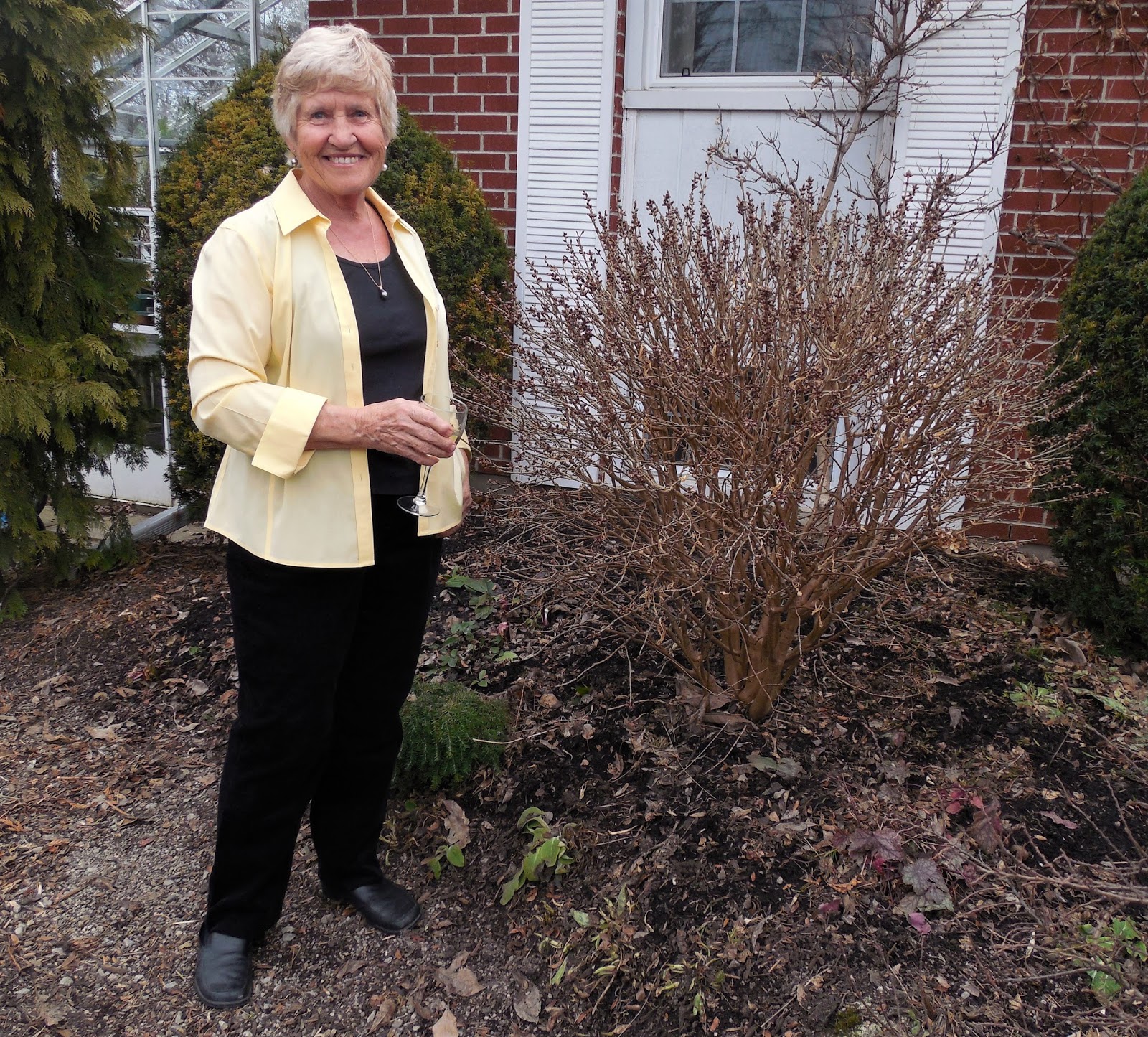
This goddess is Marion Jarvie who attended the 1986 Interim International Rock Garden Conference with Barrie Porteous, Andrew Osyany and a few other Ontarians--and became so inspired they started the Ontario Rock Garden Society, which Norman Singer brought into ARGS, and ultimately changed us from a National to International Society. Marion has become one of the leading speakers and garden designers of Canada and North America--and we have maintained a friendship for three decades thanks to NARGS.

Bob Nold has published three landmark books (Columbines, Penstemons and High and Dry): I met him through the North American Rock Garden Society, and we meet regularly at sales and meetings of our local chapter.

Boyd Cline was co-founder of Siskiyou Rare Plant Nursery, which I have described as my Correspondence College of Horticulture. He was one of my greatest mentors and a dear friend with whom I explored the Siskiyous (not enough) and we spent two unforgettable weeks in the Colorado Rockies together in 1977,. He was a stalwart of the Siskiyou chapter of NARGS. His wife won a Million dollar lottery, and he lived to be 100 years old: good things happen if you join this club.

Darrell Probst is probably the greatest hybridizer of perennials in America. I met him through NARGS: he practically invented the genus Epimedium and worked closely with our first long time NARGS president, Harold Epstein, for whom he named one of the most spectacular Epimedia: you too might have something wonderful named for you by Darrell--but only if you join NARGS!

This is Peter Korn, whose nursery and garden in Eskilby are one of the wonders of the Gardening world. He's written a fabulous book (Peter Korns Trädgård) which describes how gardens are microcosms of natural ecosystems, using his Eskilby garden as a model and example. It is also in English. Peter has invited me to come to Sweden twice: he has also convinced me that the ancient Nordic deities are still treading the earth (and creating great gardens). I would never have met him were it not for NARGS.
 |

She may not be GIANT, but Bernice (Pete) Peterson produced enormous results. She volunteered for Denver Botanic Gardens and Chatfield Farms for sixty years, working harder than most professionals (and longer hours), editing our journal, proofreading everything that came out of the office, being a receptionist and starting what has become one of the largest plant sales in the world (it has grossed over half a million dollars in two days). Pete was a charter member of the Rocky Mountain Chapter of NARGS and had the finest rock garden in Denver for much of the 20th Century. The highest award to volunteers of Denver Botanic Gardens is the "Pete Peterson" award, given once a year to the most deserving of the several thousand volunteers who follow in her pixie footsteps. Paeonia tenuifolia naturalized in her garden.

Roy Davidson contributed more articles to the NARGS bulletin than anyone else: he was the acknowledged horticultural authority on Iris, Penstemon and just about everything else native to the West. He had a spectacular garden in Bellevue, Washington. He started our Rocky Mountain Chapter in 1976 and visited us annually for decades and wrote the definitive monograph on Lewisia. He became one of my dearest friends and mentors, thanks to NARGS.
 |

Ted Kipping, the impresario of the Bay in California, when he (and I) were much younger (and slimmer). I met Ted through NARGS and we always palled around at the dozens of study weekends and conferences we attend together, most recently in October in Berkeley. He is a Lifetime member of NARGS.

I believe Tony Avent is the greatest plantsman in America: I met him through NARGS and he invited me to speak to the Piedmont Chapter when he was their President. If you don't know Plant Delights you must be living under a rock...

Wiert Nieumann, now retired as director of the fabulous Utrecht Botanical Garden in Netherlands, on a field trip to Wyoming with Kirk Fieseler of Laporte Avenue nursery (the best in the United States for alpines) when I took this picture. They are treading on Astragalus sericoleucus. If you join NARGS I might take you to see it too--but you musn't tread on it.

I took this picture at the 1981 Interim International Rock Garden Plant Conference in England--that's Will (left) and Paul (right) Ingwersen. We corresponded and swapped seed for years after that conference. I also met Wilhelm Schacht there, and started a treasured relationship with Jim and Jenny Archibald we maintained on three continents. And so many more people...

I first met Zdenek Zvolanek face to face at that same conference, and he has come to visit me (as a speaker for our chapter) at regular intervals since 1983--and this May I finally visit him!
I have met literally HUNDREDS of great gardeners thanks to NARGS--these are just a few. And they are the ones who have taught, mentored and nurtured me along the way. Funny thing is--I joined for the plants.
I hear people tell me they "aren't joiners": I sigh and chuckle inwardly: they're missing so much. I didn't join NARGS to meet and become friends with these people (nor Anita Kistler, Pamela Harper, Tony Reznicek, Mark McDonough, Roxie Gevjan Katrink Hull, Joel and Ellie Spingarn, Paul Halladin, Baldassare Mineo--really the list goes on for pages: you should probably insert your name in here:_________________. If I don't know you I probably will.).
"But" you say, "I'm not a FAMOUS person like all of those guys. You just like to NAME drop". If you think that, you really don't know me at all. I could do a blog a hundred times longer than this with the "little people". Come to think of it, I HAVE:--I feature dozens of gardens elsewhere on by blog of people who don't have nurseries, or write, or be "honchos": and I met almost all of them through NARGS as well. They are the ones who have given me my best plants (hardly a week goes by when I don't get an offer of seed or a plant). The "average" rock gardener usually has the best garden--they aren't distracted by public gardening demands, nor nursery management or writing. They are the ones who arrange for me to travel to 150 cities and 12 countries to give talks. They host me, show me natural gardens as well as their own. NARGS (and her sister organizations: the Alpine Garden Society, the Scottish Rock Garden Club, the A.G.S. of British Columbia, the Vancouver Island Rock Alpine Garden Society [the first of them all!], the New Zealand Alpine Garden Society-- which just had me tour that fabulous country), these clubs (and many, many more) that have been accused of "dying on the vine" in a recent Garden Rant. They're not dying on my watch. Their members and plants have become the warp and woof of the fabric of my life. They are wind beneath my wings. And YOURS too, if you let them! If you join promptly, you can still get seed from the fantastic NARGS seed exchange, and get the latest bulletin, which is chockablock full of dazzling pictures and great articles (I should know, I wrote one!)...
What are you waiting for: click HERE to join....



%20-%20Copy.JPG)
